MCQ
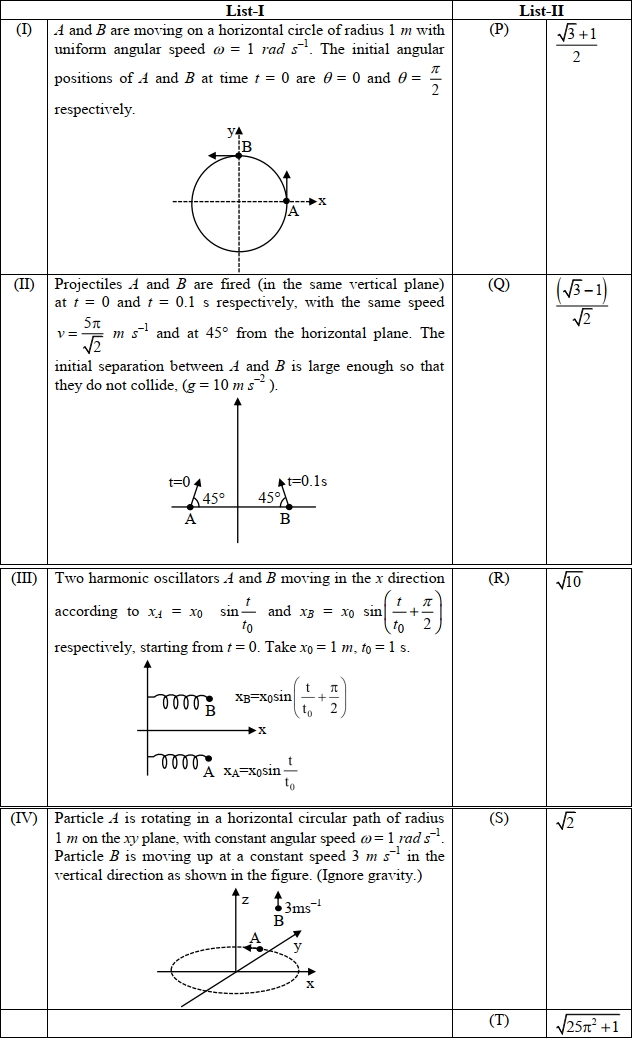
$List I$ describes four systems, each with two particles $A$ and $B$ in relative motion as shown in figure. $List II$ gives possible magnitudes of then relative velocities (in $ms ^{-1}$ ) at time $t=\frac{\pi}{3} s$.

Which one of the following options is correct?
  • A
    $I \rightarrow R , II \rightarrow T , III \rightarrow P , IV \rightarrow S$
  • B
    $I \rightarrow S , II \rightarrow P , III \rightarrow Q , IV \rightarrow R$
  • $I \rightarrow S , II \rightarrow T , III \rightarrow P , IV \rightarrow R$
  • D
    $I \rightarrow T, II \rightarrow P, III \rightarrow R , IV \rightarrow S$
Answer

Correct option: C.
$I \rightarrow S , II \rightarrow T , III \rightarrow P , IV \rightarrow R$
c
$(I)$ $v_{ BA }^2=v_A^2+v_{ B }^2-2 v_{A B} \cos \theta$

As $\omega_{\hat{A}}=\omega_{ B }, \theta=90^{\circ}$ remains constant.

Also, $v _{ A }= v _{ B }=1 m / s$

So, $v_{ BA }=\sqrt{2} m / s$

$(II)$ $\overrightarrow{ u }_{ A }=\frac{5 \pi}{2} \hat{ i }+\frac{5 \pi}{2} \hat{ j }$

$=\overrightarrow{ v }_A=\frac{5 \pi}{2} \hat{ i }+\left(\frac{5 \pi}{2}-10 \cdot \frac{\pi}{3}\right) \hat{ j }$

$=\frac{5 \pi}{2} \hat{ i }-\frac{5 \pi}{6} \hat{ j }$

$\overrightarrow{ u }_B=-\frac{5 \pi}{2} \hat{ i }+\frac{5 \pi}{2} \hat{ j }$

$\overrightarrow{ u }_{ B }=-\frac{5 \pi}{2} \hat{ i }-\left(\frac{5 \pi}{6}+1\right) \hat{ j }$

$\overrightarrow{ v }_{B . A}=-5 \pi \hat{ i }-\hat{ j }$

$v _{B A}=\sqrt{25 \pi^2+1}$

$(III)$ $x _{ A }=\sin t$

$v _{ A }=\cos t =\frac{1}{2} m / s$

$x _{ B }=\cos t$

$v _{ B }=-\sin t =-\frac{\sqrt{3}}{2} m / s$

$v _{ BA }=-\frac{\sqrt{3}}{2}-\frac{1}{2}$

$(IV)$ $\overrightarrow{ v }_{ A } \& \overrightarrow{ v }_{ B }$ are always perpendicular

So, $\left|\overrightarrow{ v }_{ BA }\right|=\sqrt{ v _{ A }^2+ v _B^2}=\sqrt{10} m / s$

Need a full question paper?

Generate a complete, print-ready paper with questions like this in minutes — across 16+ boards, with answer keys.

Start Generating Free

Similar questions

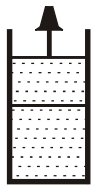
In the figure a container is shown to have a movable (without friction) piston on top. The container and the piston are all made of perfectly insulating material allowing no heat transfer between outside and inside the container. The container is divided into two compartments by a rigid partition made of a thermally conducting material that allows slow transfer of heat. The lower compartment of the container is filled with $2$ moles of an ideal monatomic gas at $700 \ K$ and the upper compartment is filled with $2$ moles of an ideal diatomic gas at $400$

K. The heat capacities per mole of an ideal monatomic gas are $C_v=\frac{3}{2} \ R, C_p=\frac{5}{2} R$, and those for an ideal diatomic gas are $C _{ v }=\frac{5}{2} \ R , C _{ P }=\frac{7}{2} R$.

$1.$ Consider the partition to be rigidly fixed so that it does not move. When equilibrium is achieved, the final temperature of the gases will be :

$(A)$ $550 \ K$ $(B)$ $525 \ K$ $(C)$ $513 \ K$ $(D)$ $490 \ K$

$2.$ Now consider the partition to be free to move without friction so that the pressure of gases in both compartments is the same. Then total work done by the gases till the time they achieve equilibrium will be:

$(A)$ $250 \ R$ $(B)$ $200 \ R$ $(C)$ $100 \ R$ $(D)$ $-100 \ R$

Give the answer question $1$ and $2.$

A system can be taken from the initial state p1, V1 to the final state p2, V2 by two different methods. Let $\Delta\text{Q}$ and $\Delta\text{W}$ represent the heat given to the system and the work done by the system. Which of the following must be the same in both the methods?

  1. $\Delta\text{Q}$

  2. $\Delta\text{W}$

  3. $\Delta\text{Q}+\Delta\text{W}$

  4. $\Delta\text{Q}-\Delta\text{W}$

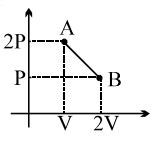
One mole of a gas expands obeying the relation as shown in the $P/V$ diagram. The maximum temperature in this process is equal to
Two waves having the intensities in the ratio of $9 : 1$ produce interference. The ratio of maximum to the minimum intensity, is equal to
The displacement of an object attached to a spring and executing simple harmonic motion is given by $ x= 2 \times 10^{-9}$ $ cos$ $\;\pi t\left( m \right)$ .The time at which the maximum speed first occurs is
A cylinder with a movable piston contains air under a pressure $p_1$ and a soap bubble of radius $'r'$ . The pressure $p_2$ to which the air should be compressed by slowly pushing the piston into the cylinder for the soap bubble to reduce its size by half will be: (The surface tension is $\sigma $ , and the temperature $T$ is maintained constant)
Which of the accompanying $PV$, diagrams best represents an isothermal process
A constant force is acting perpendicular to the velocity of a particle. For this situation which one is correct?
Which of the following is a one dimensional motion
Force acts for $20\,s$ on a body of mass $20\,kg$, starting from rest, after which the force ceases and then body describes $50\,m$ in the next $10\,s$. The value of force will be $..........\,N$