MCQ
Hertz is the unit for
  • Frequency
  • B
    Force
  • C
    Electric charge
  • D
    Magnetic flux

Answer

Correct option: A.
Frequency
(a)

Need a full question paper?

Generate a complete, print-ready paper with questions like this in minutes — across 16+ boards, with answer keys.
Start Generating Free

Similar questions

The correct relation for a triode is
A $50 \mathrm{~V}$ battery is connected across a $10 \mathrm{ohm}$ resistor. The current is $4.5$ amperes. The internal resistance of the battery is
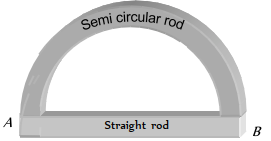
Two rods (one semi-circular and other straight) of same material and of same cross-sectional area are joined as shown in the figure. The points $A$ and $B$ are maintained at different temperature. The ratio of the heat transferred through a cross-section of a semicircular rod to the heat transferred through a cross section of the straight rod in a given time is
Image
A man runs towards mirror at a speed of $15 \mathrm{~m} / \mathrm{s}$. What is the speed of his image
A particle moves along $X$-axis in such a way that its coordinate $X$ varies with time $t$ according to the equation $x=\left(2-5 t+6 t^2\right) m$. The initial velocity of the particle is
A circular loop of radius $R$ carrying current $l$ lies in $x-y$ plane with its centre at origin. The total magnetic flux through $x-y$ plane is
Intensity of light depends upon
Rocket engines lift a rocket from the earth surface because hot gas with high velocity
When a $4\ kg$ mass is hung vertically on a light spring that obeys Hooke's law, the spring stretches by $2\ cms$. The work required to be done by an external agent in stretching this spring by $5\ cms$ will be $\left(g=9.8\right.$ metres $\left./ \operatorname{sexc}^2\right)$
A monoatomic ideal gas, initially at temperature $T_1$, is enclosed in a cylinder fitted with a frictionless piston. The gas is allowed to expand adiabatically to a temperature. $T_2$ by releasing the piston suddenly. If $L_1$ and $L_2$ are the lengths of the gas column before and after expansion respectively, then $T_1 / T_2$ is given by