Question
Highlight five areas where biotechnology has influenced our lives.

Answer

  1. Food Security: The earlier Green Revolution has certain limitations. Biotechnology can help in overcoming those limitations. It can help in improving the food production to meet the growing demand because of growing population. Production of Spirulina is an example which shows that huge quantity of nutrient can be produced by minimum use of land.
  2. Medicine: Many vaccines and other pharmaceuticals products have been made through biotechnology. Several diagnostic techniques; using biotechnology; has made it easier to diagnose a disease in time and has helped in better cure.
  3. Environmental Protection: Use of Bt cotton helps in minimising the use of pesticides. This is beneficial for the environment because it helps in saving useful insets.
  4. Crime Detection: DNA fingerprinting can be used to trace the identity of a criminal by using even the smallest remains of criminal’s body parts.
  5. Legal Disputes: Parentage disputes are being settled with the use of DNA fingerprinting.

Need a full question paper?

Generate a complete, print-ready paper with questions like this in minutes — across 16+ boards, with answer keys.

Start Generating Free

Similar questions

For food related services, granting patent for transgenic organisms is becoming complicated. Explain with example.
Read the following and answer any four questions from (i) to (v) given below: Siddharth is a chain smoker. He got into this habit in early adolescence due to peer pressure and gradually got addicted to this habit. Its now almost 20 years he is into the habit of smoking. Since few months he is experiencing pain in chest, shortness of breath, wheezing and chronic cough with phlegm. He seeked advice of a medical practitioner who diagnosed him with lung cancer. Based on the above information, answer the following questions.
  1. What do you think is the possible carcinogen responsible for Siddharth's lung cancer?
  1. Nitrosamines
  2. Benzo(a)pyrene
  3. Hydrazine
  4. All of these
  1. How is lung cancer diagnosed?
  1. Computerised tomography scan
  2. Sputum cytolog
  3. Biopsy of lung tissue
  4. All of these
  1. From which of the following type of cancer is Siddharth suffering from?
  1. Sarcoma
  2. Carcinoma
  3. Lymphoma
  4. Leukemia
  1. Select the correct statement.
  1. Surgery, radiotherapy and chemotherapy can be used to treat lung cancer.
  2. Chemotherapy involves the exposure of cancerous parts to X rays which destroy rapidly growing cancer cells.
  3. Surgical removal of lung cancer tissue is suggested at advanced stage 4.
  4. Monoclonal antibodies can effectively treat lung cancer and can cure it completely.
  1. Assertion: Lung cancer if not treated at an early stage can spread to other initial organs of the body.
Reason: Cancer cell have uncontrolled proliferation and ability to invade new sites (metastasis).
  1. Both assertion and reason are true and reason is the correct explanation of assertion.
  2. Both assertion and reason are true but reason is not the correct explanation of assertion.
  3. Assertion is true but reason is false.
  4. Both assertion and reason are false
A regulatory body working under $\text{MoEF}$ for the release of transgenic crop is $............:$
Read the following and answer any four questions from (i) to (v) given below:
Ginkgo tree has been saved from extinction by selective breeding followed by channeling into trade of nature lovers. This is an ex-situ conservation, where endangered species are protected from all adverse factors. Offspring produced in captive breeding are released in natural habitat for acclimatisation.
  1. What is the significance of offsite collections?
  1. Restock depleted populations.
  2. Protection of endangered species.
  3. Reintroduce species in wild.
  4. All of these.
  1. Which of the following is not an ex-situ conservation?
  1. Wetlands
  2. Orchards
  3. Aquaria
  4. Botanical gardens.
  1. Select the incorrect statements for ex-situ conservation.
  1. It is conservation of species outside their natural habitats.
  2. Endangered species are kept under human supervision and provided all the essentials.
  3. The species population recovers in natural environment.
  4. Both (b) and (c).
  1. Conditions maintained in seed banks for orthodox seeds are:
  1. Low moisture content.
  2. Anaerobic conditions.
  3. Low temperature.
  4. All of these.
  1. Assertion: Animal species which have become extinct in wild continue to be maintained in zoological parks.
Reason: Captive breeding is the conservation of those cases where these is no realistic chance of in-situ survival.
  1. Both assertion and reason are true and reason is the correct explanation of assertion.
  2. Both assertion and reason are true but reason is not the correct explanation of assertion.
  3. Assertion is true but reason is false.
  4. Both assertion and reason are false.
Give information about primary and secondary lymphoid organ ### Explain lymphatic organs of human lymphatic system. (Diagram is not required)
Explain pBR322 with its cloning sites, enzymes with well labeled diagram.###Explain: cloning sites. (Diagram is not necessary)
Read the following and answer any four questions from (i) to (v) given below:
The foundations of recombinant DNA (rDNA) were laid by the discovery of restriction enzymes. These enzymes are present in many bacterias where they function as a part of their defense mechanism called the Restriction Modification system (RM system). Molecular basis of this system was explained first by Werner Arber in 1962. The Restriction Modification system consists of two components:
  • A restriction enzyme (called restriction endonuclease) identifies the introduced foreign DNA and cuts it into pieces.
  • The second component is a modification enzyme (methylase) that adds a methyl group to DNA at specific site to protect it from the restriction enzyme cleavage.
  1. Restriction endonucleases are enzymes present in ________ where they function as a part of _______ mechanism.
  1. (i) bacteria (ii) digestive
  2. (i) protists (ii) transcription
  3. (i) plant cells (ii) replication
  4. (i) prokaryotes (ii) defence
  1. Which of the following statements regarding modification enzyme is correct?
  1. It adds methyl group to one or two bases usually within the host DNA sequence to protect it from the restriction enzyme.
  2. It adds ethyl group to one or two bases usually within the sequence recognised by the restriction enzymes.
  3. It adds methyl group to only one of bases within the foreign DNA sequence that is recognised by the restriction enzymes.
  4. None of these.
  1. Which of the following is a type II restriction enzyme?
  1. Alu I
  2. EcoR I
  3. BamH I
  4. All of these.
  1. Which of the following is the first discovered restriction endonuclease?
  1. Sal I
  2. EcoR I
  3. Hind II
  4. EcoR II
  1. Components of Restriction Modification System include?
  1. Restriction enzyme.
  2. Modification enzyme.
  3. Lysing enzyme.
  4. Both (a) and (b).
Read the following text carefully and answer the questions that follow:
Transgenic animals can serve as factories that in some cases, may produce large amounts of proteins more efficiently. Transgenic mice have been engineered to express human antibodies by introducing a large segment of human DNA encoding human immunoglobulin genes. In transgenic large animals such as cows or sheep proteins of pharmaceutical value can be produced in large quantities in milk which is later purified. Transgenes can be used to alter many phenotypic properties including growth rate, fat composition, milk production, hair texture, etc.
i. In transgenic animals, i.e. cow and sheep proteins of pharmaceutical value are produced in large quantities in which gland. (1)
ii. Why is mouse the most preferred animal for studies on gene transfer? (1)
iii. Why does the production of transgenic animals take place? (2)
OR
Assertion (A): Transgenic mice have been engineered to express human antibodies. (2)
Reason (R): Large segments of human DNA encoding human immunoglobulin have been transferred to mice.
a. Both A and R are true and R is the correct explanation of A.
b. Both A and R are true but R is not the correct explanation of A.
c. A is true but R is false.
d. A is false but R is true.
Write a short note on transcription unit.### Explain : Transcription unit
Read the following and answer any four questions from (i) to (v) given below:
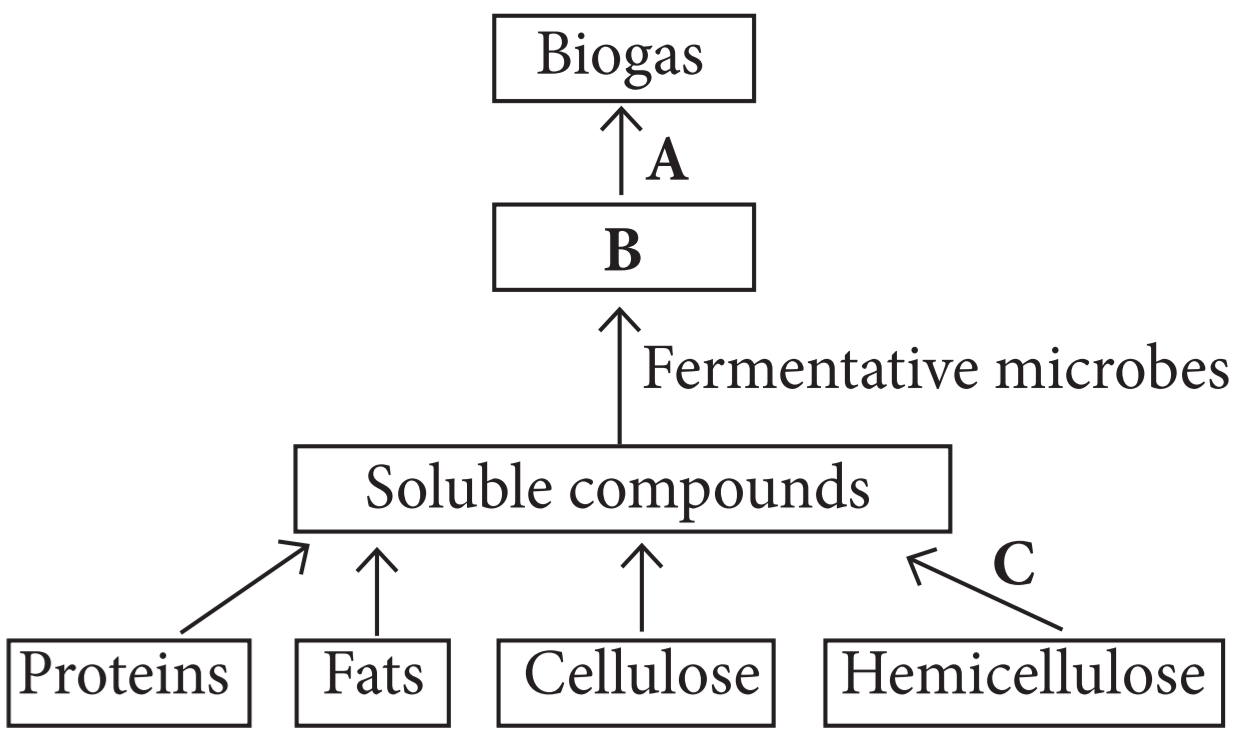
Villagers in a place near Chambur started planning to make power supply for agricultural purposes from cow dung. 'Tiley have started a biogas plant for the purpose. Study the flow chart for biogas production given below and answer the following questions.
  1. Biagas is composed of majorly:
  1. Methane, $\mathrm{CO}_2$ and $\mathrm{O}_2$
  2. $\mathrm{CO}_2, \mathrm{H}_2 \mathrm{~S}$ and H
  3. Methane, $\mathrm{CO}_2$
  4. $\mathrm{H}_2 \mathrm{~S}, \mathrm{H}$ and $\mathrm{O}_2$
  1. In the given flow chart, 'A' denotes:
  1. Aerobic bacteria.
  2. Methanogenic bacteria.
  3. Cellulose degrading bacteria.
  4. Yeast and protozoa.
  1. What is represented by 'B' in the flow chart?
  1. Carbohydrates.
  2. Protein polymers.
  3. Organic acids.
  4. Fat globules.
  1. 'C' in the given flow chart causes:
  1. Aerobic breakdown of complex organic compounds.
  2. Anaerobic digestion of complex organic compounds.
  3. Fermentation of organic compounds.
  4. Fermentation of monomers.
  1. If 'A' is not added in the procedure.
  1. Methane will not be formed.
  2. $\mathrm{CO}_2$ will not be formed.
  3. Organic compounds will not be converted to $\mathrm{H}_2 \mathrm{S}$
  4. $\mathrm{O}_2$ will not be formed.