→ A transcription unit in DNA is defined primarily by the three regions in the DNA :
(i) The Structural gene
(ii) A Promoter
(iii) A Terminator
(i) A structural gene:
→ There is a convention in defining the two strands of the DNA in the structural gene of a transcription unit.
→ Since the two strands have opposite polarity and the DNA-dependent RNA polymerase also catalyse the polymerisation in only one direction, that is, 5' → 3',
→ Template strand:
→ The strand that has the polarity 3' → 5' acts as a template, and is also referred to as template strand.
Coding strand :
→ The other strand which has the polarity (5'→ 3') and the sequence same as RNA (except thymine at the place of uracil), is displaced during transcription. Strangely, this strand (which does not code for anything) is referred to as coding strand.
→ All the reference point while defining a transcription unit is made with coding strand.
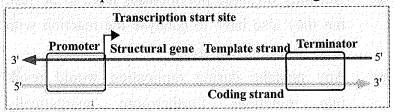
Schematic structure of a transcription unit
(ii) A promoter:
→ The promoter and terminator flank the structural gene in a transcription unit.
→ The promoter is said to be located towards 5'-end (upstream) of the structural gene (the reference is made with respect to the polarity of coding strand).
→ It is a DNA sequence that provides binding site for RNA polymerase and it is the presence of a promoter in a transcription unit that also defines the template and coding strands.
(iii) A Terminator:
→ By switching its position with terminator, the definition of coding and template strands could be reversed.
→ The terminator is located towards 3'-end (downstream) of the coding strand and it usually defines the end of the process of transcription.
→ There are additional regulatory sequences that may be present further upstream or downstream to the promoter.