Question
Himani while watching a TV programme based on life in polar region observed that all animals in polar regions possess larger size. Also, smaller animals are not found in that region. She asked about this surprising fact to her teacher.
  1. Why smaller animals (e.g. humming birds) are rarely found in polar regions?
  2. What are the adaptations shown by polar animals?
  3. What are the chief characteristics of polar region animals?
  4. What values are shown by Himani?

Answer

  1. Smaller animals are rarely found in polar regions because such animals have larger surface area relative to their volume and they tend to loose body heat very fast when it is cold outside. This is the reason they are rarely found in polar regions.
  2. Animals that live in polar regions are adaptable to polar environments by features like the presence of thick skin coat, tendency to change colour or camouflage to white in snow and high metabolic rate. These features allow animals to adapt in colder environments
  3. Chief characteristics of polar region animals are:
  1. Large size.
  2. Hairy skin.
  3. lipid layer beneath the skin.
  1. Himani showed curiosity and eagerness for learning new things.

Need a full question paper?

Generate a complete, print-ready paper with questions like this in minutes — across 16+ boards, with answer keys.

Start Generating Free

Similar questions

A large number of married couples the world over are childless. It is shocking to know that in India the female partner is often blamed for the couple being childless.
  1. Why in your opinion the female partner is often blamed for such situations in India? Mention any two values that you as a biology student can promote to check this social evil.
  2. State any two reasons responsible for the cause of infertility.
  3. Suggest a technique that can help the couple to have a child where the problem is with the male partner.
Enumerate the points that have to be considered for successful bee-keeping.
State and explain the 'Law of Independent Assortment' with a suitable example.
A flower of tomato plant following the process of sexual reproduction produce 240 viable seeds.
Answer the following questions giving reasons:
What would have been the minimum number of ovules present in the ovary?
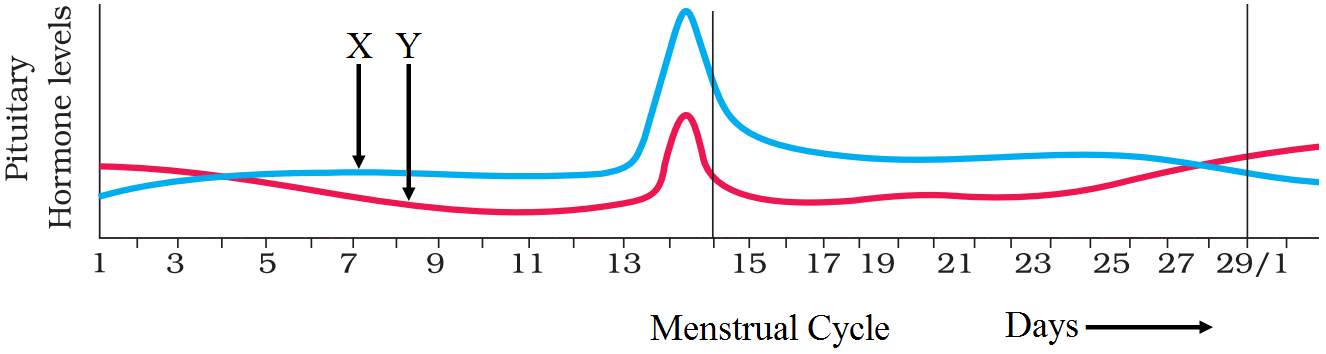
Study the graph given below and answer the questions that follow:
Explain the ovarian events (i), (ii) and (iii) under the influence of hormones ‘X’ and ‘Y’.
Define gametogenesis. How does cell division take place during gamete formation?
Describe the pathway followed by phosphorus in an ecosystem.
Give any two examples of insect resistant transgenic crops.
Describe Avery, McCarty and MacLeod’s experiments.
Your school has been selected by the Department of Education to organise and host an interschool seminar on "Reproductive Health - Problems and Practices". However, many parents are reluctant to permit their wards to attend it. Their argument is that the topic is "too embarrassing."
Put forth four arguments with appropriate reasons and explanation to justify the topic to be very essential and timely.