MCQ
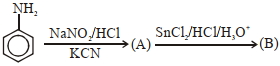
$HN{O_2}$ acts as
- AOxidising agent
- BReducing agent
- ✓Both (a) and (b)
- DIts solution is stable
It reduces potassium permanganate, potassium dichromate, ${H_2}{O_2}$ and other strong oxidising agents. It oxidises strong reducing agents such as hydroiodic acid, sulphurous acid etc.
It oxidises $F{e^{ + 2}}$ into $F{e^{ + 3}}$ in acidic medium;
$F{e^{ + 2}} + HN{O_2} + {H^ + }\, \to \,F{e^{ + 3}} + NO + {H_2}O$
It reduces acidified $KMn{O_4}$.
$2KMn{O_4} + 3{H_2}S{O_4} + 5HN{O_2}\, \to $
${K_2}S{O_4} + 2MnS{O_4} + 3{H_2}O + 5HN{O_3}$
Generate a complete, print-ready paper with questions like this in minutes — across 16+ boards, with answer keys.
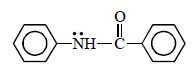
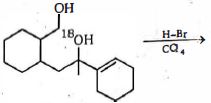
$(I)$ $ Ph -COCH_3$
$(II)$ $CH_3 -CO -CH_3$
$(III)$ $CH_3 -CHO$
$(IV)$ $Ph -COCH_2 -CH_3$
Assertion $A$ : Aniline on nitration yields ortho, meta and para nitro derivatives of aniline.
Reason $R$: Nitrating mixture is a strong acidic mixture.
In the light of the above statements, choose the correct answer from the options given below
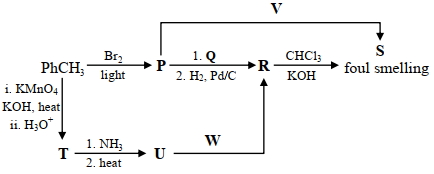
$(A)$ $Q = KNO _2, W = LiAlH _4$
$(B)$ $R =$ benzenamine, $V = KCN$
$(C)$ $Q = AgNO _2, R =$ phenylmethanamine
$(D)$ $W = LiAlH _4, V = AgCN$