MCQ
$HN{O_3}$ in aqueous solution yields
- A$NO_3^ - $ and ${H^ + }$
- ✓$NO_3^ - $ and ${H_3}{O^ + }$
- C$NO_2^ - $ and $O{H^ - }$
- D${N_2}{O_5}$ and ${H_2}O$
Generate a complete, print-ready paper with questions like this in minutes — across 16+ boards, with answer keys.
$\begin{array}{*{20}{c}}
{C{H_3}\,\,\,\,\,\,\,\,\,\,\,\,\,\,\,\,\,\,\,\,\,\,\,\,\,\,\,\,\,\,\,\,\,\,\,\,\,\,\,\,\,\,\,\,\,} \\
{|\,\,\,\,\,\,\,\,\,\,\,\,\,\,\,\,\,\,\,\,\,\,\,\,\,\,\,\,\,\,\,\,\,\,\,\,\,\,\,\,\,\,\,\,\,\,\,\,\,\,\,\,\,} \\
{C{H_3} - CH - C{H_2} - O - C{H_2} - C{H_3}}
\end{array}\,+ HI \, \xrightarrow{{Heated}}$
Which of the following compounds will be formed ?
Assertion $(A)$ : $\mathrm{S}_{\mathrm{N}} 2$ reaction of $\mathrm{C}_6 \mathrm{H}_5 \mathrm{CH}_2 \mathrm{Br}$ occurs more readily than the $\mathrm{S}_{\mathrm{N}} 2$ reaction of $\mathrm{CH}_3 \mathrm{CH}_2 \mathrm{Br}$.
Reason $(R)$ : The partially bonded unhybridized p-orbital that develops in the trigonal bipyramidal transition state is stabilized by conjugation with the phenyl ring.
In the light of the above statements, choose the most appropriate answer from the options given below:
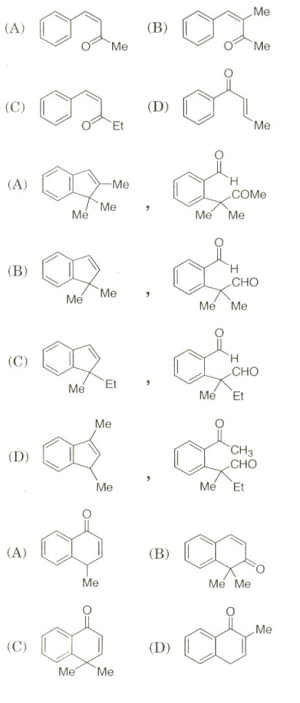
${P} \xrightarrow[\substack{\text { 2. } \mathrm{H}^{+}, \mathrm{H}_2 \mathrm{O} \\ \text { 3. } \mathrm{H}_2 \mathrm{SO}_4, \Delta}]{\text { 1. MeMgBr }}Q \xrightarrow[\text { 2. } \mathrm{Zn}, \mathrm{H}_2 \mathrm{O}]{1 . \mathrm{O}_3} {R} \xrightarrow[\text { 2. } \Delta]{1 . \mathrm{OH}^{-}} {S}$
$1.$ The structure of the carbonyl compound ${P}$ is
$Image$
$2.$ The structures of the products ${Q}$ and ${R}$, respectively, are
$Image$
$3.$ The structure of the product ${S}$ is
$Image$
Give hte answer question $1,2$ and $3.$