MCQ
$HNO_3 + P_4O_{10} \to 4HPO_3 + X$ . $X$ is
  • $N_2O_5$
  • B
    $NO_2$
  • C
    $NO$
  • D
    $N_2O_3$

Answer

Correct option: A.
$N_2O_5$
a
We know that,

$4 HNO _3+ P _4 O _{10} \rightarrow 4 HPO _3+2 N _2 O _5$

The product, $x$ is dinitrogen pentaoxide $\left( N _2 O _5\right)$.

Need a full question paper?

Generate a complete, print-ready paper with questions like this in minutes — across 16+ boards, with answer keys.

Start Generating Free

Similar questions

Lanthanide contraction occurs because
In a photochemical reaction, the ratio of number of dissociate molecules and number of quanta of absorbed energy is called
How fast the reaction is at $25\,^oC$ as compared to $0\,^oC$. If the activation energy is $65\, KJ$ ......  times
For the following reaction

$2 X + Y \xrightarrow{i} P$

the rate of reaction is $\frac{ d [ P ]}{ dt }=k[ X ]$. Two moles of $X$ are mixed with one mole of $Y$ to make $1.0 L$ of solution. At $50 s , 0.5$ mole of $Y$ is left in the reaction mixture. The correct statement(s) about the reaction is(are)

(Use: $\ln 2=0.693$ )

$(A)$ The rate constant, $k$, of the reaction is $13.86 \times 10^{-4} s ^{-1}$.

$(B)$ Half-life of $X$ is $50 s$.

$(C)$ At $50 s ,-\frac{ d [ X ]}{ dt }=13.86 \times 10^{-3} mol L ^{-1} s ^{-1}$.

$(D)$ At $100 s ,-\frac{ d [ Y ]}{ dt }=3.46 \times 10^{-3} mol L ^{-1} s ^{-1}$.
$Na_2S + Na_2[Fe(CN)_5NO] \to Na_4[Fe(CN)_5NOS]$ ; oxidation number of $Fe$ in reactant (complex) and product (complex) are
Which of the following complex or complex ion can have optically active isomer-
In the isoelectronic series of metal carbonyl, the $CO$ bond strength is expected to increase in the order
A metal $(A)$ on heating in nitrogen gas gives compound $B$. $B$ on treatment with $\mathrm{H}_{2} \mathrm{O}$ gives a colourless gas which when passed through $\mathrm{CuSO}_{4}$ solution gives a dark blue-violet coloured solution. $A$ and $B$ respectively, are
Which of the following cannot be prepared by Sandmeyer’s reaction?
$a.$ Chlorobenzene.
$b.$ Bromobenzene.
$c.$ Iodobenzene.
$d.$ Fluorobenzene.
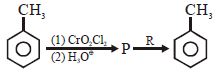
$P$ and $R$ respectively are