Hooke's law is applicable for ....
Easy


Download our appand get started for free
Experience the future of education. Simply download our apps or reach out to us for more information. Let's shape the future of learning together!No signup needed.*
Similar Questions
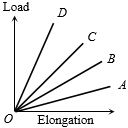
- 1View SolutionThe load versus elongation graph for four wires of the same material is shown in the figure. The thickest wire is represented by the line
- 2If one end of a wire is fixed with a rigid support and the other end is stretched by a force of $10 \,N,$ then the increase in length is $0.5\, mm$. The ratio of the energy of the wire and the work done in displacing it through $1.5\, mm$ by the weight isView Solution
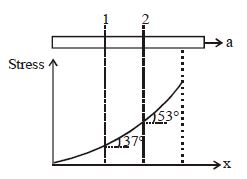
- 3Rod of constant cross-section moves towards right with constant acceleration. Graph of stress and distance from left end is given as in figure. If density of material of rod at cross section $1$ is $9$ $\frac{{gm}}{{c{m^3}}}$ . Find density at cross section $2$.View Solution
.......... $\mathrm{gm} / \mathrm{cm}^{3}$
- 4Compressibility per unit atm. pressure of water is $'\sigma '$ and if due to pressure $P$ there is decrement in volume $V$, find change is volumeView Solution
- 5A steel wire $1.5\,m$ long and of radius $1\,mm$ is attached with a load $3\,kg$ at one end the other end of the wire is fixed it is whirled in a vertical circle with a frequency $2\,Hz$ . Find the elongation of the wire when the weight is at the lowest position $(Y = 2 \times 10^{11}\,N/m^2$ and $g = 10\,m/s^2)$View Solution
- 6The elongation of a wire on the surface of the earth is $10^{-4} \; m$. The same wire of same dimensions is elongated by $6 \times 10^{-5} \; m$ on another planet. The acceleration due to gravity on the planet will be $\dots \; ms ^{-2}$. (Take acceleration due to gravity on the surface of earth $=10 \; m / s ^{-2}$ )View Solution
- 7The compressibility of water is $6 \times 10^{-10} N ^{-1} m ^{2} .$ If one litre is subjected to a pressure of $4 \times 10^{7} Nm ^{-2}$ the decrease in its volume is (in $cc$)View Solution
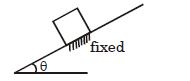
- 8View SolutionAssume that a block of very low shear modulus is fixed on an inclined plane as shown. Due to elastic forces it will deform. What will be the shape of the block ?
- 9The stress-strain curves are drawn for two different materials $X$ and $Y$. It is observed that the ultimate strength point and the fracture point are close to each other for material $X$ but are far apart for material $Y$. We can say that materials $X$ and $Y$ are likely to be (respectively)View Solution
- 10A $100\,m$ long wire having cross-sectional area $6.25 \times 10^{-4}\,m ^2$ and Young's modulus is $10^{10}\,Nm ^{-2}$ is subjected to a load of $250\,N$, then the elongation in the wire will be :View Solution