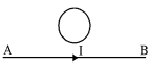
- AElectric lines of force never cross each other.
- BElectric lines of force end at a positive.
- CThe electric field charge inside a conductor are infinity.
- DLines of electric field point towards regions of lower potential.
Explanation:
If the lines cross each other at a given location, then there must be two distinctly different values of electric field with their own individual direction at that given location. This could never be the case. Therefore the lines representing the field cannot cross each other at any given location.
Electric field end at a negative charge.
Along the electric field line potential drops.
Generate a complete, print-ready paper with questions like this in minutes — across 16+ boards, with answer keys.
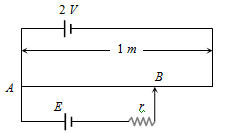
In the given figure, battery E is balanced on 55 cm length of potentiometer wire but when a resistance of 10 W is connected in parallel with the battery then it balances on 50 cm length of the potentiometer wire then internal resistance r of the battery is

|
(a) 1 W |
(b) 3 W |
(c) 10 W |
(d) 5 W |
Three right angled prisms of refractive indices and
are fixed together using an optical glue as shown in figure. If a ray passes through the prisms without suffering any deviation, then
|
(a) |
(b) |
|
(c) |
(d) 1 + |
Large transformers, when used for some time, become hot and are cooled by circulating oil. The heating of transformer is due to
|
(a) Heating effect of current alone |
|
(b) Hysteresis loss alone |
|
(c) Both the hysteresis loss and heating effect of current |
|
(d) None of the above |
White light is incident on the interface of glass and air as shown in the figure. If green light is just totally internally reflected then the emerging ray in air contains
|
(a) Yellow, orange, red |
(b) Violet, indigo, blue |
|
(c) All colours |
(d) All colours except green |