Hot water kept in a beaker placed in a room cools from ${70^o}C$ to $60°C$ in $4$ minutes. The time taken by it to cool from ${69^o}C$ to ${59^o}c$ will be
Medium


Download our appand get started for free
Experience the future of education. Simply download our apps or reach out to us for more information. Let's shape the future of learning together!No signup needed.*
Similar Questions
- 1View SolutionThe amount of radiation emitted by a perfectly black body is proportional to
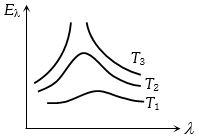
- 2View SolutionVariation of radiant energy emitted by sun, filament of tungsten lamp and welding arc as a function of its wavelength is shown in figure. Which of the following option is the correct match
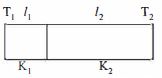
- 3One end of a thermally insulated rod is kept at a temperature $T_1$ and the other at $T_2$ . The rod is composed of two sections of length $l_1$ and $l_2$ and thermal conductivities $K_1$ and $K_2$ respectively. The temperature at the interface of the two section isView Solution
- 4View SolutionIf the radius and length of a copper rod are both doubled, the rate of flow of heat along the rod increases ....... times
- 5Hot water kept in a beaker placed in a room cools from ${70^o}C$ to $60°C$ in $4$ minutes. The time taken by it to cool from ${69^o}C$ to ${59^o}c$ will beView Solution
- 6The radiation energy density per unit wavelength at a temperature $T$ has a maximum at a wavelength $\lambda _0$. At temperature $2T$, it will have a maximum at a wavelengthView Solution
- 7View SolutionA thin paper cup filled with water does not catch fire when placed over a flame. This is because
- 8The black body spectrum of an object $O _1$ is such that its radiant intensity (i.e. intensity per unit wavelength interval) is maximum at a wavelength of $200\,nm$. Another object $O _2$ has the maximum radiant intensity at $600\,nm$. The ratio of power emitted per unit area by source $O _1$ to that of source $O _2$ isView Solution
- 9Two spheres made of same material have radii in the ratio $1: 2$ Both are at same temperature. Ratio of heat radiation energy emitted per second by them isView Solution
- 10A solid sphere and a hollow sphere of the same material and size are heated to the same temperature and allowed to cool in the same surroundings. If the temperature difference between each sphere and its surroundings is $T$, thenView Solution