A solid sphere and a hollow sphere of the same material and size are heated to the same temperature and allowed to cool in the same surroundings. If the temperature difference between each sphere and its surroundings is $T$, then
Medium


Download our appand get started for free
Experience the future of education. Simply download our apps or reach out to us for more information. Let's shape the future of learning together!No signup needed.*
Similar Questions
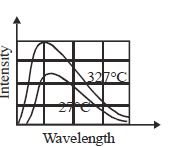
- 1The spectrum of a black body at two temperatures $27\,^oC$ and $327\,^oC$ is shown in the figure. Let $A_1$ and $A_2$ be the areas under the two curves respectively. Find the value of $\frac {A_2}{A_1}$View Solution
- 2The area of a hole of heat furnace is ${10^{ - 4}}{m^2}$. It radiates $1.58 \times {10^5}$ calories of heat per hour. If the emissivity of the furnace is $0.80$ , then its temperature is....... $K$View Solution
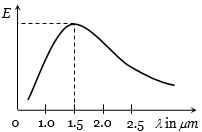
- 3In the figure, the distribution of energy density of the radiation emitted by a black body at a given temperature is shown. The possible temperature of the black body is ....... $K$View Solution
- 4Which of the following statements is/are $CORRECT$ Correct option areView Solution
$(i)$ a body with large reflectivity is a poor emitter
$(ii)$ a brass tumbler feels much colder than a wooden tray on a chilly day
$(iii)$ the earth without its atmosphere would be inhospitably cold
$(iv)$ heating systems based on circulation of steam are more efficient in warming a building than those based on circulation of hot water
- 5The figure shows a system of two concentric spheres of radii $r_1$ and $r_2$ and kept at temperatures $T_1$ and $T_2$, respectively. The radial rate of flow of heat in a substance between the two concentric spheres is proportional toView Solution

- 6If the sun’s surface radiates heat at $6.3 \times {10^7}W{m^{ - 2}}$. Calculate the temperature of the sun assuming it to be a black body $(\sigma = 5.7 \times {10^{ - 8}}W{m^{ - 2}}{K^{ - 4}})$View Solution
- 7The end $A$ of a rod $AB$ of length $1\,m$ is maintained at $80\,^oC$ and the end $B$ at $0\,^oC.$ The temperature at a distance of $60\,\,c.m.$ from the end $A$ is......... $^oC$View Solution
- 8$Assertion :$ Bodies radiate heat at all temperature.View Solution
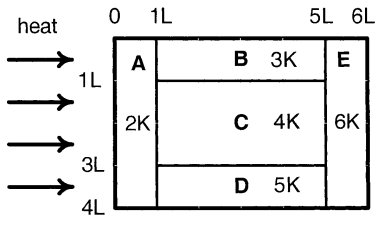
$Reason :$ Rate of radiation of heat is proportional to the fourth power of absolute temperature. - 9A composite block is made of slabs $A, B, C, D$ and $E$ of different thermal conductivities (given in terms of a constant $K$ ) and sizes (given in terms of length, $L$ ) as shown in the figure. All slabs are of same width. Heat $'Q'$ flows only from left to right through the blocks. Then in steady state $Image$View Solution
$(A)$ heat flow through $A$ and $E$ slabs are same.
$(B)$ heat flow through slab $E$ is maximum.
$(C)$ temperature difference across slab $E$ is smallest.
$(D)$ heat flow through $C =$ heat flow through $B +$ heat flow through $D$.
- 10A spherical black body with a radius of $24\;cm$ radiates $440\;W$ power at $500\;K$. If the radius were halved and the temperature doubled, the power radiated in watt would beView Solution