Question
How an ore is concentrated by froth floatation process?
Answer

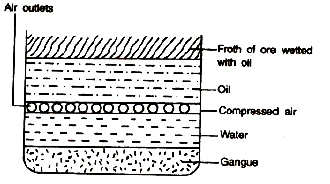
Concentrated of an ore by froth floatation process : This process depends on preferential wettability of the ore and the gangue particles. Crushed ore is taken in
a large tank containing water and certain oils. The ore particles get wetted by the oil and the gangue particles get wetted by water. The mixture is then agitated with
the help of compressed air. The ore particles that get wetted with the oil form a froth on the top, and can be scooped out. This method is used for the concentration
of sulphide ores.

Figure : Froth floatation process

Need a full question paper?

Generate a complete, print-ready paper with questions like this in minutes — across 16+ boards, with answer keys.

Start Generating Free

Similar questions

A compound of lead has following percentage composition$, Pb = 90.66\%, O = 9.34\%.$ Calculate empirical formula of a compound. $[Pb = 207, O = 16]$
Potassium (Atomic No. $19$) and chlorine (Atomic No. $17$) react to form a compound. On the basis of electronic concept, explain
(i) oxidation
(ii) reduction
(iii)oxidising agent
(iv)reducing agent
How does Avogadro's law explain Gay $-$ lussac's law of combining volumes?
The pH values of three solutions P, Q and R are given in the table.
SolutionpH value
P12
Q2
R7
Answer the following questions :
(i) Which solution will have no effect on litmus solution?
(ii) Which solution will liberate CO2 when reacted with sodium carbonate?
(iii) Which solution will turn red litmus blue?
(iv) Which solution will turn blue litmus red?
(v) Which solution is also known as alkali?
M is a metal above hydrogen in the activity series and its oxide has the formula $M_2O$. The oxide when dissolved in water forms the corresponding hydroxide which is a good conductor of electricity. In the above context answer the following:
(i) What kind of combination exists between $M$ and $O$?
(ii) How many electrons and there in the outermost shell of $M$?
(iii) Name the group to which M belongs
(iv) State the reaction taking place in the cathode
(v) Name the product at the anode
What volume of air (containing $20 \% O _2$ by volume) will be required to burn completely $10 cm ^3$ each of methane and acetylene?
$CH _4+2 O _2 \rightarrow CO _2+2 H _2 O$
$2 C _2 H _2+5 O _2 \rightarrow 4 CO _2+2 H _2 O$
(i) Look at the given figure and identify the law applicable here. State the law.
Image
(ii) 120 cm3 of hydrogen gas is mixed with 120 cm3 of oxygen gas and then exploded. Calculate the composi- tion of the resulting mixture on cooling.
A solution of hydrogen chloride in water is prepared. The following substances are added to separate portions of the solution:
S.No. Substance added Gas Evolved Odour
1 Calcium carbonate ______ ______
2 Magnesium ribbon ______ ______
3 Manganese (IV) oxide with heating ______ ______
4 Sodium Sulphide _______ _______
Complete the table by writing the gas evolved in each case and its odour.
The figure given below illustrates the apparatus used in the laboratory preparation of nitric acid.
Image
(i) Name A (a liquid), B (a solid) and C (a liquid).
(ii) Write an equation to show how nitric acid undergoes decomposition.
(iii) Write the equation for the reaction in which copper is oxidised by concentrated nitric acid.
Explain the structure of Hydronium ion.