Question
How are 0.50mol Na2CO3 and 0.50M Na2CO3 different?

Answer

Molar mass of Na2CO3 = (2 × 23) + 12.00 + (3 × 16)
= 106g mol–1
Now, 1 mole of Na2CO3 means 106g of Na2CO3.
$\therefore$  0.5mol of Na2CO3  $=\frac{106\text{g}}{1\text{mole}}\times0.5\text{mol} \text{ Na}_2\text{CO}_3$
= 53g Na2CO3
⇒ 0.50M of Na2CO3 = 0.50mol/L Na2CO3
Hence, 0.50mol of Na2CO3 is present in 1L of water or 53g of Na2CO3 is present in 1L of water.

Need a full question paper?

Generate a complete, print-ready paper with questions like this in minutes — across 16+ boards, with answer keys.
Start Generating Free

Similar questions

Arrange the following as stated.
  1. Increasing order of bond dissociation energy of N2, O2, F2, Cl2.
  2. Decreasing order of electropositive character of Cu, Fe, Mg.
  3. Increasing order of valency of nitrogen in HNO3, HNO2, NO2.
Out of electron and proton which one will have, a higher velocity to produce matter waves of the same wavelength? Explain it.
1. Consider the same expansion, but this time against a constant external pressure of 1 atm.
2. What do you mean by entropy?
3. Air contains about $99 \%$ of $N _2$ and $O _2$ gases. Why they do not combine to form NO under the standard conditions? Standard Gibbs energy of formation of $NO ( g )$ is $86.7 kJ mol ^{-1}$.
Symbols $\text{ }^{79}_{35}\text{Br}$ and $\text{ }^{79}\text{Br}$ can be written, whereas symbols $\text{ }^{35}_{79}\text{Br}$ and $\text{ }^{35}\text{Br}$ are not acceptable. Answer briefly.
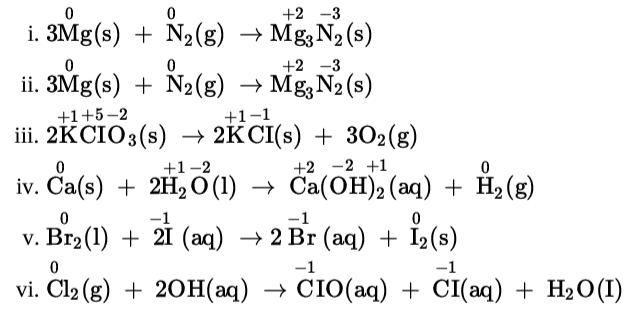
Identify the type of redox reaction taking place in the following.
Image
  1. Classify the following substances into elements, compounds and mixtures.
  1. 2-Carat gold.
  2. Sucrose.
  3. Diamond.
  4. Sodium chloride.
  1. How many significant figures are there in each of the following numbers?
  1. 12
  2. 2.084
  1. What do you understand by the rounding off a number?
  2. Write balanced chemical equations for the following:

Na2CO(aq) + NO(g) + NO3(g) → NaNO2(aq) + CO2(g)

0.90g of organic compound on combustion gave 2.64g of CO2, and 0.63g of H2O. Calculate the percentage of C and H in the compound.
lf 6.022 × 10²³ molecules of N2, react completely with H2 according to the equation:
N2(g) + 3H2(g) → 2NH3(g),
then calculate the number of molecules of NH3 formed.
Standard molar enthalpy of formation, $\Delta_\text{f}\text{H}^\ominus$ is just a special case of enthalpy of reaction, $\Delta_\text{r}\text{H}^\ominus$. Is the $\Delta_\text{r}\text{H}^\ominus$ for the following reaction same as $\Delta_\text{f}\text{H}^\ominus$? Give reason for your answer.

$\text{CaO}(\text{s})+\text{CO}_2(\text{g})\rightarrow\text{CaCO}_3(\text{s});$ $\Delta_\text{f}\text{H}^\ominus=-178.3\text{kJ}\ \text{mol}^{-1}$

The value of $\Delta_\text{f}\text{H}^\ominus$ for NH3 is -91.8kJ mol-1 . Calculate enthalpy change for the following reaction:

$2\text{NH}_3(\text{g})\rightarrow\text{N}_2(\text{g})+3\text{H}_2(\text{g})$

Although heat is a path function but heat absorbed by the system under certain specific conditions is independent of path. What are those conditions? Explain.