Question
How are homogenous solutions different from heterogeneous solution? Explain with examples.
| S.No. | Homogeneous solutions | Heterogeneous solutions |
| 1. | Components are uniformly mixed. | Components arc not uniformly mixed. |
| 2. | It has single phase. | It has two or more distinct phases. |
| 3. | No boundaries of separation between the components. | There are visible boundaries between the components. |
| 4. | Components are invisible to naked eye. | Components are visible to naked eye. |
| 5. | Examples of Homogeneous solutions are salt solution, lemonade, petrol etc. | Examples of Heterogeneous solutions are chalk in water, petrol in water, and sand in water. |
Generate a complete, print-ready paper with questions like this in minutes — across 16+ boards, with answer keys.
| Formula | Name of the ion | ||
| 1) | H_(3)O^(+) | - | ? |
| 2) | ? | - | Acetate ion ? |
| 3) | PO_(4)^(3-) | - | ? |
| 4) | ? | - | Sulphate ion |
| 5) | NO_(3)^(-) | - | ? |
A compound in which two Covalent bonds are formed.
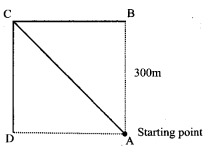 (i) What is the total distance to be covered by the athletes?
What could be the final temperature of a mixture of 100 g of water at 90 °C and 600g of water at 20°C.