Question
How are metals refined by the electrolytic process? Describe the electrolytic refining of copper with the help of a neat labelled diagram.
Answer

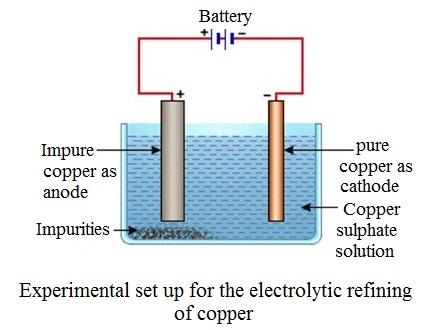
For the refining of an impure metal by the process of electrolysis, a thick block of impure metal is made anode (connected to +ve terminal of the battery) and a thin strip of the pure metal is made cathode (connected to -ve terminal of battery). A water soluble salt (of the metal to be refined) is taken as electrolyte. On passing current, impure metal dissolves from the anode and goes into the electrolyte solution. And pure metal from the electrolyte deposits on the cathode. Electrolytic refining of copper: In an electrolytic tank, acidified copper sulphate $\left( CuSO _4^{+}\right.$dil ute $\left.H _2 O _4\right)$ solution forms the electrolyte. A block of impure copper is made into an anode by connectig the positive terminal of a power supply (battery). A thin strip of highly pure copper metal is the cathode of the cell. The negative terminal of the power supply is connected to it.
A small electric curr ent is passed through the cell. Atoms from the anode enter the electrolyte. The copper from the anode gets converted into copper sulphide. An equal number of copper atoms from the solution get deposited on the cathode. This is to keep the concentration of the solution constant. Impurities from the anode block either remain in solution or collect below the anode, as they are unable to displace copper form the sulphate solution. The insoluble impurities remain in the electrolyte and are called anode mud. Copper sulphate solution contains ions of $Cu ^{2+}$ and $SO _4{ }^{2-}$. . The following reactions take
place at the anode and cathode when an electric current is passed. $\text{At cathode:}\ \ \ \ \ \ \ \ \ \ \ \ \ \text{Cu}^{2+}\ \ \ \ \ \ \ \ \ \ \ \ \ \ \ \ \ \ \ \xrightarrow[\text{(Reduction)}]{+2\text{electrons}}\ \ \ \ \ \ \ \ \ \ \ \ \ \ \ \ \ \ \text{Cu}\\\ \ \ \ \ \ \ \ \ \ \ \ \ \ \ \ \ \ \ \ \ \ \ \ \ \ \ \text{Copper ion}\ \ \ \ \ \ \ \ \ \ \ \ \ \ \ \ \ \ \ \ \ \ \ \ \ \ \ \ \ \ \ \ \ \ \ \ \ \ \ \ \ \ \ \ \text{Copper atom}\\\ \ \ \ \ \ \ \ \ \ \ \ \ \ \ \ \ \ \ \ \ \text{(From electrolyte)}\ \ \ \ \ \ \ \ \ \ \ \ \ \ \ \ \ \ \ \ \ \ \ \ \ \ \ \ \ \ \ \ \text{(Deposits on cathode)}$ $\text{At anode:}\ \ \ \ \ \ \ \ \ \ \ \ \ \ \ \ \ \ \ \ \ \ \text{Cu}\ \ \ \ \ \ \ \ \ \ \ \ \ \ \ \ \ \ \ \xrightarrow[\text{(oxidation)}]{-2\text{electrons}}\ \ \ \ \ \ \ \ \ \ \ \ \ \ \ \ \ \ \text{Cu}^{2+}\\\ \ \ \ \ \ \ \ \ \ \ \ \ \ \ \ \ \ \ \ \ \ \ \ \ \ \ \text{Copper atom}\ \ \ \ \ \ \ \ \ \ \ \ \ \ \ \ \ \ \ \ \ \ \ \ \ \ \ \ \ \ \ \ \ \ \ \ \ \ \ \ \ \ \ \ \text{Copper ion}\\\ \ \ \ \ \ \ \ \ \ \ \ \ \ \ \ \ \ \ \text{(From impure anode)}\ \ \ \ \ \ \ \ \ \ \ \ \ \ \ \ \ \ \ \ \ \ \ \ \ \ \ \ \ \ \ \ \text{(Goes into electrolyte)}$ Pure copper is scraped or removed from the cathode. Anode becomes thinner as the electrolysis process proceeds. Some important metals like gold and silver are present in the anode mud. These can be recovered separately.

Need a full question paper?

Generate a complete, print-ready paper with questions like this in minutes — across 16+ boards, with answer keys.
Start Generating Free

Similar questions

Divide the wastes generated from your house into biodegradable and non-biodegradable categories. Suggest methods for their disposal.
List the sign conventions for reflection flight by spherical mirrors. Draw a diagram and apply these conventions in the determination of focal length of spherical mirror which forms a three times magnified real image of an object placed 16 cm infront of it.
Describe how washing soda is produced starting from sodium chloride (common salt). Write equations of all the reactions involved.
Define the term dispersion of white light. Name the colour of light which bends (i) the most, (ii) the least, while passing through a glass prism Draw a ray diagram to Justify your answer.
Construct ray diagrams to illustrate the formation of a virtual image using:
  1. A converging lens, and.
  2. A diverging lens.
Give reasons why a woman should avoid frequent pregnancies. Explain the following methods of contraception giving one example of each.
  1. Barrier method.
  2. Chemical method.
Give a detailed explanation on the following.Versatile nature of carbon.
How do the following change on going from left to right in a period of the periodic table?
  1. Chemical reactivity of elements.
  2. Nature of oxides of elements Give examples in support of your answer.
In question 44, what are the combinations of character in the $F_2$ progeny? What are their ratios?
Draw a labelled diagram of the human digestive system. With the help of this diagram, describe the process of digestion of food in man (humans).