Question
How are water and minerals transported in plants?

Answer

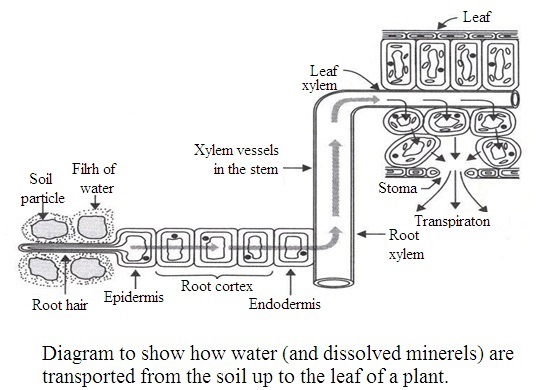
Water and minerals are transported to various parts of the plant by xylem tissues called xylem vessels and tracheids. Plants take in water from the soil through the roots. The water containing minerals called cell sap is carried by the xylem vessels to all the parts of the body. The roots have root hairs to absorb water and minerals from the soil by diffusion and then pass from cell to cell by osmosis through epidermis, root cortex, endodermis and then reach the root xylem. The water enters the root xylem into the stem xylem and then reaches the leaves from the petioles.

Need a full question paper?

Generate a complete, print-ready paper with questions like this in minutes — across 16+ boards, with answer keys.
Start Generating Free

Similar questions

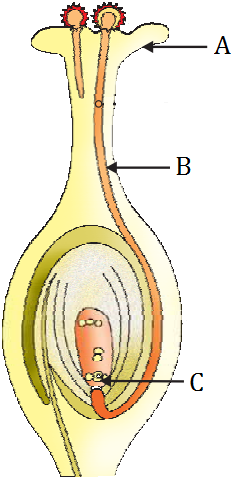
Identify A, B and C in the given diagram and write one function of each.
What would happen if green plants disappear from earth?
Generally, when metals are treated with mineral acids, hydrogen gas is liberated but when metals (except Mn and Mg ), treated with $HNO _3$, hydrogen is not liberated, why?
A Mendelian experiment consisted of breeding tall pea plants bearing violet flowers with short pea plants bearing white flowers. The progeny all bore violet flowers, but almost half of them were short. This suggested that the genetic make up (or genotype) of the tall parent can be depicted as:
  1. TTWW
  2. TTww
  3. TtWW
  4. TtWw
Give reason for your choice.
Explain why, methanol is much more dangerous to drink than ethanol.
Nikita took Zn, Al, Cu, Fe, Mg and Na metal and put each metal in cold water and then hot water. She reacted the metal with steam
(i) Name the metal which reacts with cold water.
(ii) Which of the above metals react with steam?
(iii) Name the metal which reacts with hot water.
(iv) Arrange these metals in order of increasing reactivity.
What will happen if slow moving neutrons are made to strike the atoms of a heavy element ${ }_{92} U ^{235}$ ? What?
A substance X, which is an oxide of a group 2 element, is used intensively in the cement industry. This element is present in bones also. On treatment with water it forms a solution which turns red litmus blue. Identify X and also write the chemical reactions involved.
Comment on the following statements:
(i) Bee sting is treated with baking soda paste whereas wasp sting is treated with dilute vinegar.
(ii) Farmers treat soil with quicklime when tilling.
(iii) Ancient sculptures and marble structures are conserved by treating them with certain chemicals."
Using electron-dot diagrams which show only the outermost shell electrons, show how a molecule of nitrogen, N, is formed from two nitrogen atoms. What name is given to this type of bonding? (Atomic number of nitrogen is 7)