Questions

[3 Mark Questions]

🎯

Test yourself on this topic

27 questions · timed · auto-graded

Question 13 Marks
What are herbivores, carnivores and omnivores? Give two examples of each.
Answer
  1. Herbivores: Those animals which eat only plants are called herbivores.
Example: Goat and cow.
  1. Carnivores: Those animals which eat only other animals as food are called carnivores.
Example: Tiger and Lion.
  1. Omnivores: Those animals which eat both plants and animals are called omnivores.
Example: Human Being and dog.
View full question & answer
Question 23 Marks
Define breathing. State the differences between breathing and respiration.
Answer
The mechanism by which an organism obtains oxygen from the air and releases carbon-dioxide is called breathing.Difference between breathing and respiration:Breathing:
  1. Breathing is a simple process.
  2. Breathing involves taking in oxygen from the air and releasing carbon dioxide into the air.
  3. Breathing is a physical process.
Respiration:
  1. Respiration is a complex process.
  2. Respiration includes breathing as well as the oxidation of food in the cells of the organism to release energy.
  3. Respiration is a bio-chemical process.
View full question & answer
Question 33 Marks
What is lymph? State two major functions of lymph.
Answer
Lymph is a light yellow liquid. It is a medium of circulation in human body which flows only in one direction – from body tissues to the heart. The functions of lymph are:
  1. It takes part in the nutritive process of the body.
  2. It protects the body by killing the germs drained out of the body tissues with the help of lymphocytes contained in the lymph nodes, by making antibodies.
  3. It helps in removing the waste products like fragments of dead cells etc.
View full question & answer
Question 43 Marks
What is meant by ‘systolic pressure’ and ‘diastolic pressure’? What are their normal values?
Answer
The maximum pressure at which the blood leaves the heart through the main artery (Aorta) during contraction phase is called systolic pressure. The minimum pressure in the arteries during relaxation phase of the heart is called the diastolic pressure.
The normal blood pressure values are: Systolic pressure: 120mm Hg. Diastolic pressure: 80mm Hg.
View full question & answer
Question 53 Marks
Describe the circulatory system in a fish.
Answer
The fish has a two chambered heart. Oxygenation of the blood takes place in the gills. The oxygenated blood from the gills is supplied to the body parts of the fish where oxygen is utilized and carbon-dioxide enters into it making it deoxygenated. The deoxygenated blood returns to the heart to be pumped into gills again.
View full question & answer
Question 63 Marks
Leaves of a healthy potted plant were coated with vaseline. Will this plant remain healthy for long? Give reason for your answer.
Answer
This plant will not remain healthy for long because vaseline coating closes the stomatal pores on the leaves due to which:
  1. Plant will not get oxygen for respiration.
  2. Plant will not get carbon dioxide for photosynthesis, and.
  3. Plant will not get water (and minerals) due to stoppage of transpiration.
View full question & answer
Question 73 Marks
How is food transported in plants?
Answer
Transportation of food in plants: The transport of food from the leaves to other parts of the plant is called translocation. Phloem tissue transports the food from the leaves to the other parts of the plant. The movement of food in phloem takes place by utilising energy. The sugar made in the leaves is loaded into the sieve tubes of phloem by using ATP. Water enters the sieve tube containing sugar which causes high pressure and pushes the food to all the parts of the plant having low pressure. This is how the food is transported according to the needs of the plant.
View full question & answer
Question 83 Marks
What will happen to the rate of photosynthesis in a plant under the following circumstances?
  1. Cloudy day in morning but bright sunshine in the afternoon.
  2. No rainfall in the area for a considerable time.
  3. Gathering of dust on the leaves.
Answer
  1. Decreases in morning but increases in the afternoon.
  2. Decreases.
  3. Decreases.
View full question & answer
Question 93 Marks
State the various steps involved in the process of photosynthesis.
Answer
The photosynthesis takes place in the following three steps:
  1. Absorption of sunlight energy by chlorophy ll.
  2. Conversion of light energy into chemical energy and splitting of water into hydrogen and oxygen by light energy.
  3. Reduction of carbon dioxide by hydrogen to form carbohydrates like glucose by utilising the chemical energy.
View full question & answer
Question 103 Marks
State the functions of blood in our body.
Answer
Functions of blood:
  1. It carries oxygen from the lungs to different parts of the body.
  2. It carries carbon-dioxide from the body cells to the lungs for breathing out.
  3. It carries digested food from the small intestine to all the parts of the body.
  4. It carries waste product called urea from the liver to the kidneys for excretion in the form of urine.
  5. It protects the body from diseases.
View full question & answer
Question 113 Marks
What are the various types of heterotrophic nutrition?
Answer
The various types of Heterotrophic nutrition are:
  1. Saprotrophic nutrition.
  2. Parasitic nutrition.
  3. Holozoic nutrition.
View full question & answer
Question 123 Marks
Describe the process of respiration in fish.
Answer
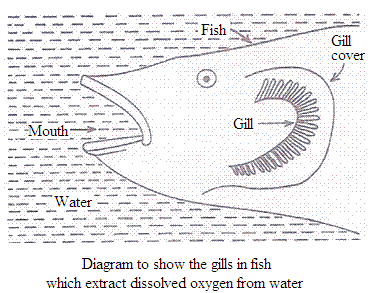
Respiration and fish: The fish has special organ of breathing called gills on both the sides of its head. The gills are covered by gill covers. The fish lives in water which contains dissolved oxygen. The fish breathes by taking in water through its mouth and sending it over the gills. When water passes over the gills, the gills extract dissolved oxygen from the water. The extracted oxygen is absorbed by the blood and carried to all the parts of the fish. The carbon-dioxide produced by respiration is brought back by the blood into the gills for expelling into the surrounding water.
View full question & answer
Question 133 Marks
State the three common features of all the respiratory organs like skin, gills and lungs.
Answer
The common features of all respiratory organs? skin, gills and lungs are:
  1. All the respiratory organs have a large surface area to get enough oxygen.
  2. All the respiratory organs have thin walls for easy diffusion and exchange of respiratory gases.
  3. All the respiratory organs like skin, gills and lungs have a rich blood supply for transporting respiratory gases.
View full question & answer
Question 143 Marks
What are the different ways in which glucose is oxidised to provide energy in various organisms? Give one example of each.
Answer
There are two ways in which glucose is oxidized to provide energy in various organisms:
  1. Anaerobic respiration? The respiration which takes place without oxygen is called anaerobic respiration.
Example: Yeast and some bacteria break down glucose into ethanol and carbon-dioxide.
  1. Aerobic respiration? The respiration which uses oxygen is called aerobic respiration.
Example: Plants and animals break down glucose completely into carbon-dioxide and water to release energy.
View full question & answer
Question 153 Marks
State the differences between artery, vein and capillary.
Answer
 
Artery
Vein
Capillary
i.
It is a thick walled blood vessel.
It is a thin walled blood vessel.
It is an extremely narrow blood vessel having very thin walls.
ii.
It carries blood from the heart to different parts of the body.
It brings blood from the different parts of the body to the heart.
They form an extensive network throughout all living cells in the body and connect arteries and veins.
iii.
It can dilate or constrict depending on the regulatory requirement of the body.
It cannot dilate or constrict.
It can dilate or constrict according to the requirement of the tissue.
iv.
It does not contsin any valve.
It contains simple valves which permit blood flow only towards the heart.
It does not contain any valves.
View full question & answer
Question 163 Marks
What is meant by dental caries? How are they caused?
Answer
The formation of small cavities (or holes) in the teeth due to the action of acid forming bacteria and improper dental care is called dental caries. This happens as follows:
When we eat sugary food, the bacteria in our mouth act on sugar to produce acids. These acids dissolve the calcium salts from the tooth enamel and then from dentine forming small cavities in the tooth over a period of time in our mouth act on sugar to produce acids. These acids dissolve the calcium salts from the tooth enamel and then from dentine forming small cavities in the tooth over a period of time.
View full question & answer
Question 173 Marks
What is hypertension? Why is it caused? What harm can it do?
Answer
High blood pressure is called hypertension. It is caused by the constriction of very small arteries which results in increased resistance to blood flow. Very high blood pressure can lead to rupture of artery and internal bleeding.
View full question & answer
Question 183 Marks
What is the difference between autotrophic nutrition and heterotrophic nutrition?
Answer
Autotrophic Nutrition: It is that mode of nutrition in which an organism makes its own food from the simple inorganic materials like carbon dioxide and water present in the surroundings (with the help of sunlight energy)Example: Green Plants
Heterotrophic Nutrition: It is that mode of nutrition in which an organism cannot make its own food from simple inorganic materials like carbon dioxide and water, and depends on other organisms for its food.
Example: Animals.
View full question & answer
Question 193 Marks
A dialysis machine contains long tubes coiled in a tank containing dialysing solution:
  1. Of what substance are the tubes made?
  2. What does the dialysing solution contain?
  3. Name the main waste which passes into the dialysing solution.
Answer
  1. Cellulose.
  2. Water, glucose, salts in similar concentration to those in normal blood.
  3. Urea.
View full question & answer
Question 203 Marks
How are water and minerals transported in plants?
Answer
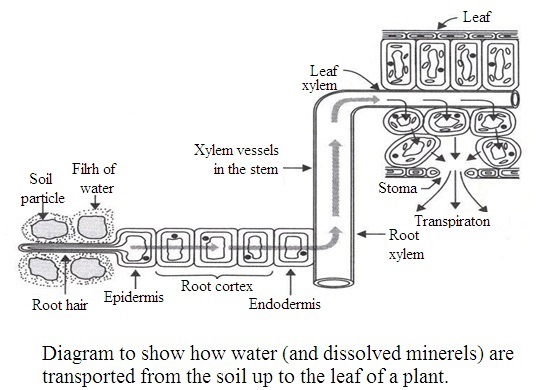
Water and minerals are transported to various parts of the plant by xylem tissues called xylem vessels and tracheids. Plants take in water from the soil through the roots. The water containing minerals called cell sap is carried by the xylem vessels to all the parts of the body. The roots have root hairs to absorb water and minerals from the soil by diffusion and then pass from cell to cell by osmosis through epidermis, root cortex, endodermis and then reach the root xylem. The water enters the root xylem into the stem xylem and then reaches the leaves from the petioles.
View full question & answer
Question 213 Marks
What are the differences between aerobic and anaerobic respiration? Name some organisms that use anaerobic mode of respiration.
Answer
  1. Aerobic respiration.
  1. Aerobic respiration takes place in the presence of oxygen.
  2. Complete breakdown of food occurs in aerobic respiration.
  3. The end products in aerobic respiratin are carbon dioxide and water.
  4. Aerobic respiration produces a considerable amount of energy.
Anaerobic respiration.
  1. Anaerobic respiration takes place in the absence of oxygen.
  2. Partial break down of food occurs in anaerobic respiration.
  3. The end products in anaerobic respiration are ethanol and carbon dioxide (in yeast) and lactic and (in animal muscles).
  4. Much less energy is produced in anaerobic respiration.
  1. Yeast and some bacteria.
View full question & answer
Question 223 Marks
What substances are contained in gastric juice? What are their functions?
Answer
The gastric juice contains three substances hydrochloric acid, the enzyme pepsin and mucus.
Functions:
Hydrochloric acid: It makes the medium of gastric juice acidic so that the enzyme pepsin can digest the proteins properly and also kills any bacteria that might have entered the stomach with food.
Pepsin: The enzyme pepsin digests the proteins present in the food and converts them into smaller molecules.
Mucus: The mucus helps to protect the stomach wall from its own secretions of hydrochloric acid.
View full question & answer
Question 233 Marks
What is meant by the terms ‘single circulation’ and ‘double circulation’?
Answer
Single circulation is a type of circulatory system in which the blood passes through the heart only once in one complete cycle of the body. Double circulation is a circulatory system in which the blood travels twice through the heart in one complete cycle of the body.
View full question & answer
Question 243 Marks
Describe the process of respiration in the following parts of a plant:
  1. Root.
  2. Stem.
  3. Leaves.
Answer
  1. Respiration in roots: The roots of a plant take the oxygen required for respiration from the air present in - between the soil particles by the process of diffusion. The roots have extensions of epidermal cells of a root called root hair which are in contact with the air in the soil. Oxygen diffuses from root hairs and reaches all the other cells of the root for respiration. Carbon-dioxide gas produced in the cells of the root during respiration moves out through the root hairs by the process of diffusion. Thus, the respiration in roots occurs by diffusion of respiratory gases through the root hairs.
  2. Respiration in stems: The stems of herbaceous plants takes place through stomata. The oxygen from the air diffuses into the stem of a herbaceous plant through stomata and reaches all the cells for respiration. The carbon-dioxide produced diffuses out through stomata. In woody stems, the bark has lenticels for the exchange of gases.
  3. Respiration in leaves: The leaves of a plant has tiny pores called stomata through which the exchange of respiratory gases takes place by diffusion. Oxygen from air diffuses into a leaf through stomata and reaches all the cells, where it is used for respiration and the carbon-dioxide produced diffuses out from the leaf into the air through stomata.
View full question & answer
Question 253 Marks
Name the type of respiration in which the end products are:
  1. a. $C _2 H _1 OH$ and $CO _2$.
    b. $CO _2$ and $H _2 O$.
    c. Lactic acid.
Give one example of each case where such a respiration can occur.
Answer
  1. Anaerobic respiration in yeast.
  2. Aerobic respiration in humans.
  3. Anaerobic respiration in muscle tissue of animals.
View full question & answer
Question 263 Marks
What is meant by human circulatory system? Name the organs of the circulatory system in humans.
Answer
Human circulatory system is a system which is responsible for the transport of materials inside the body. The various organs of the circulatory system in humans are:
Heart, Arteries, Veins and Capillaries.
View full question & answer
Question 273 Marks
Describe the process of respiration in State whether it is anaerobic respiration or aerobic respiration.
Answer
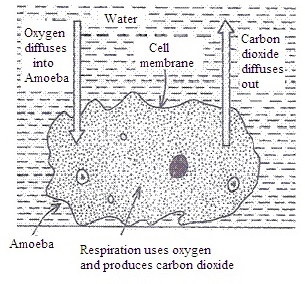
  1. Respiration in amoeba: Amoeba depends on simple diffusion of gases for breathing. The diffusion of gases takes place through the thin cell membrane of amoeba. Amoeba lives in water which contains dissolved oxygen. The oxygen from water diffuses into the body of amoeba through its cell membrane. The oxygen spreads quickly into the whole body and is used for respiration inside the amoeba cell. The process of respiration produces carbon-dioxide which diffuses out through its cell membrane into the surrounding water.
  1. It is aerobic respiration.
View full question & answer
[3 Mark Questions] - Science STD 10 Questions - Vidyadip