Maharashtra BoardEnglish MediumSTD 12 ScienceChemistryAlcohols, Phenols and Ethers4 Marks
Question
How can alcohols be distinguished with the help of Lucas reagent?
✓
Answer
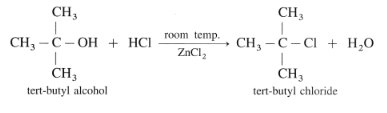
Lucas reagent is a mixture of concentrated $HCl$ and anhydrous $ZnCl _2$. It is used to distinguish between primary, secondary and tertiary alcohols. Alcohol with Lucas reagent forms an alkyl chloride, $R - Cl$ which is insoluble and gives cloudiness and forms separate layer. The time required for cloudiness to appear is based on the type of the alcohol and its reactivity : (1) Primary alcohol : It reacts with the Lucas reagent very slowly and on heating forms alkyl chloride. The cloudiness and separation of a layer takes place after a long time on heating. $\underset{\text { Ethyl alcohol }}{ C _2 H _5- OH }+\underset{\text { conc. }}{ HCl } \xrightarrow[\Delta]{\text { anhydrous } ZnCl _2} \underset{\text { Ethyl chloride }}{ C _2 H _5- Cl }+ H _2 O$ (2) Secondary alcohol : It reacts with the Lucas reagent much faster to form alkyl chloride. The cloudiness and separation of layer takes place slowly. (3) Tertiary alcohol : It reacts immediately with the Lucas reagent at room temperature to form alkyl chloride. The cloudiness and separation of layer takes place instantaneously.
Need a full question paper?
Generate a complete, print-ready paper with questions like this in minutes — across 16+ boards, with answer keys.