Maharashtra BoardEnglish MediumSTD 12 ScienceChemistryAldehydes, Ketones and Carboxylic Acids4 Marks
Question
Explain why carboxylic acids are much weaker acids than mineral acids.
✓
Answer
Carboxylic acids are the organic compounds which are acidic in nature. However, compared to mineral acids like $HCl$ or $H _2 SO _4$. the carboxylic acids are weaker acids.
The strength of acidity depends upon their ability to release $H ^{+}$ions. Greater the ease with which they release $H ^{+}$ions, stronger is the acid.
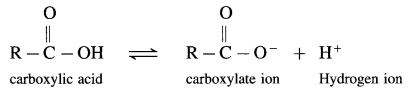
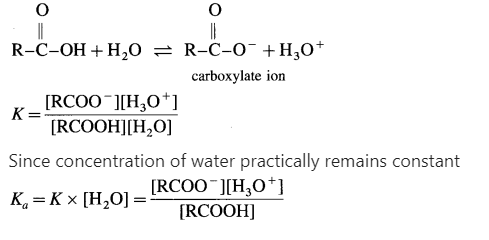
Carboxylic acids when dissolved in water, pcoduce $H ^{+}$due to its dissociation. (it does not dissociate completely.) The mineral acid-s like $HCl , H _2 SO _4$ release $H ^{+}$ion to a larger extent as they dissociatc almost complctcly in aqueous solution for e.g. $HCl \rightarrow H ^{+} Cl ^{-}$thus carboxylic acids are weaker than mineral acids. The equilibrium exists in aqueous solution of carboxylic acid as where $K _{ a }$ is acidity constant Larger the value $K _{ a }$ greater is the extent of ionization and stronger is the acid. But strength of acids is expressed in ternis of their $pK _{ a }$ values. Smaller the value of $pK _{ a }$. the stronger is the carboxylic acid. Here $pK _{ a }$ value of carboxylic acids is higher than mineral acids. Hence, carboxylic acids arc weaker than mineral acids.
Need a full question paper?
Generate a complete, print-ready paper with questions like this in minutes — across 16+ boards, with answer keys.