Question
How can phenol be converted to aspirin?

Answer

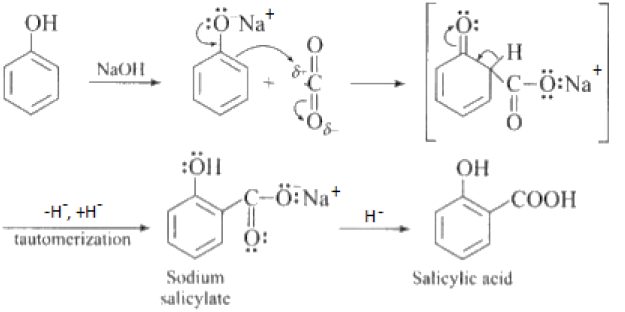
Phenol is converted into salicylic acid. The reaction is usually carried out by allowing sodium phenoxide to absorb carbon dioxide and then heating the product to $400 K$ and $4-7$ atm pressure. The first unstable intermediate is formed which undergoes a proton shift to form sodium salicylate. The subsequent acidification of sodium salicylate gives.
Image
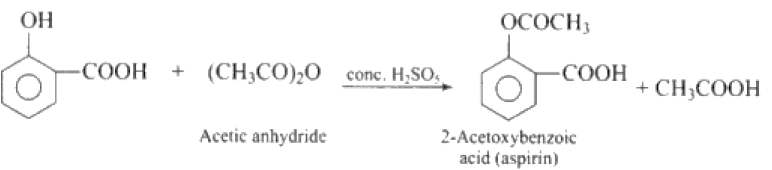
Then aspirin is obtained by acetylating salicylic acid with acetic anhydride and conc. $H_2SO_4$Image
The preparation of Aspirin from salicylic acid is an example of an electrophilic substitution reaction in which carbon dioxide is an electrophile.

Need a full question paper?

Generate a complete, print-ready paper with questions like this in minutes — across 16+ boards, with answer keys.
Start Generating Free

Similar questions

Give reasons for the following$:$
  1. The transition metals generally form coloured compounds.
  2. $E^\circ$ value for $\ce{(Mn^{3+}|Mn^{2+})}$ is highly positive than that for $\ce{(Cr^{3+}|Cr^{2+})}$ couple.
  3. The chemistry of actinoids elements is not so smooth as that of the lanthanoids.
State Henry’s Law. What is the significance of $K_H$?
How the following conversions can be carried out?
i. 2-Bromopropane to 1-bromopropane
ii. Chloroethane to butane
iii. Benzene to diphenyl
Give reason:
(i) Transition elements exhibit higher enthalpies of atomisation.
(ii) In aqueous solution, $Cr ^{2+}$ is stronger reducting agent than $Fe ^{2+}$.
(iii) The second ionisation enthalpy of Cu is higher then $Z n$.
Calculate the mass of a non-volatile solute $($molar mass $40\ g\ mol^{–1})$ which should be dissolved in $114 g$ octane to reduce its vapour pressure to $80\%.$
Define isomerism and tell its types.
Draw a diagram of galvanie cell and explain the following reaction
$Zn ( s )+2 Ag ^{+}( aq ) \longrightarrow Zn ^{2+}( aq )+2 Ag ( s )$ which electrode is electronegative in this reaction? what are the charge carriers in a cell? write the reactions occurring at each electrode.
Write only equations to obtain 1º, 2º and 3° alcohols from aldehydes and ketones.
How many $mL$ of $0.1\ M\ HCl$ are required to react completely with $1\ g$ mixture of $Na_2CO_3$ and $NaHCO_3$ containing equimolar amounts of both?
Predict, giving reasons, the order of basicity of the following compounds in $(i)$ gaseous phase and $(ii)$ in aqueous solutions $\ce{(CH_3)_3N, (CH_3)_2NH, CH_3NH_2, NH_3.}$