Question
How can various sources help us understand history?

Answer

Various sources play a crucial role in helping us understand history by providing diverse perspectives, detailed evidence, and contextual insights. Here’s how different types of sources contribute to our understanding of history :
• Primary Sources : Original documents or physical objects created during the time under study. For example-inscriptions, ancient literature, letters, diaries, official documents, photographs, artifacts, and newspapers.
• Secondary Sources : Works that interpret, analyze, or summarise primary sources. For example: Books, articles, documentaries, and reviews.
• Oral Histories : Recorded interviews and spoken accounts from individuals who experienced or witnessed historical events. For example: Interviews, recordings, and transcriptions.
Need a full question paper?

Generate a complete, print-ready paper with questions like this in minutes — across 16+ boards, with answer keys.

Start Generating Free

Similar questions

In the stories of Shalini and Tenzing, we see examples of joint families. What do you think are the aspects of modern living that make some couples opt for a nuclear family (i.e. living apart from older generations or other relatives)? What could be some advantages as well as disadvantages of the two kinds of families?
Describe some conflicts in our society and the role of the government in resolving them?
What is the primary sector? How is it different from the secondary sector? Give two examples.
Read the following news item :
Nimone is a village on the Chauphula-Shirur Road. Like many others, this village has also been facing a severe water shortage for the last few months and villagers depend on tankers for all their needs. Bhagavan Mahadeo Lad (35) of this village was beaten with sticks, iron rods, and axes by a group of seven men. The incident came to light when some villagers brought a badly injured Lad to the hospital for treatment. In the FIR recorded by the police Lad said that he was attacked when he insisted that the water in the tanker must be emptied into the storage tanks constructed as part of the water supply scheme by Nimone Gram Panchayat so that there would be equal distribution of water. However, he alleged that the upper caste men were against this and told him that the tanker water was not meant for the lower castes.
1. Why was Bhagavan beaten ?
2. Do you think that the above is a case of discrimination? Why ?
Write a note on Oceans.
Analyse the interdePCndc1 among the primary, secondary, and tertiary economic sectors. Illustrate your answer with an example to show how these sectors work together in a typical supply chain.
Several poor people in the city work as domestic servants as well as work for the Corporation, keeping the city clean. Yet the slums in which they live are quite filthy. This is because these slums seldom have any water and sanitation facilities. The reason often given by the Municipal Corporation is that the land in which the poor have set up their homes does not belong to them and that slum-dwellers do not pay taxes. However, people living in middle-class neighborhoods pay very little in taxes compared to the amount of money the corporation spends on them in setting up parks, street lighting facilities, regular garbage collection etc. Also as you read in this chapter, the property taxes collected by the Municipality makes up only 25-30 percent of its money.
Why do you think it is important that the Corporation should spend more money on slum localities ? Why is it important that the Municipal Corporation provide the poor in the city with the same facilities that the rich get ?
The diet of Harappans was quite diverse. Validate the statemtent.
Make a list of characteristics of a good urban local body.
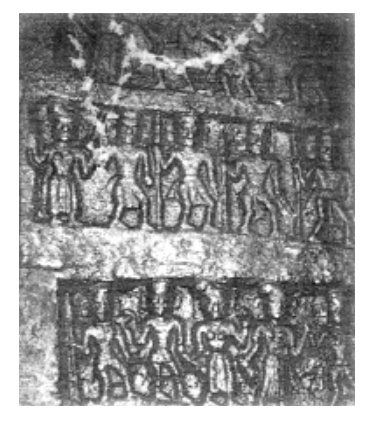
Look at the picture of a carved stone and answer the following questions.
Image
(a) Whom do these five figures shown in the picture represent ?
(b) In which part of India was this carved stone found ?
(c) How is this carved stone related to the tribal culture of that area ?
(d) What conclusion did the anthropologist K.S. Singh draw from such carved stones and the folklores ?