Question
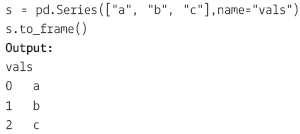
How can we convert a Series to DataFrame?
Series.to_frame(name=None)
name: Refers to the object. Its Default value is None.
If it has one value, the passed name will be substitutedfor the series name.
Generate a complete, print-ready paper with questions like this in minutes — across 16+ boards, with answer keys.
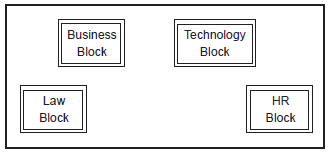
Center to Center distances between various blocks/center is as follows:
| Law Block to business Block | 40m |
| Law block to Technology Block | 80m |
| Law Block to HR center | 105m |
| Business Block to technology Block | 30m |
| Business Block to HR Center | 35m |
| Technology block to HR center | 15m |
Number of computers in each of the blocks/Center is as follows:
| Law Block | 15 |
| Technology Block | 40 |
| HR center | 115 |
| Business Block | 25 |
(a) Suggest the most suitable place (i.e., Block/Center) to install the server of this University with a suitable reason.
(b) Suggest an ideal layout for connecting these blocks/centers for a wired connectivity.
(c) Which device will you suggest to be placed/installed in each of these blocks/centers to efficiently connect all the computers within these blocks/centers.
(d) The university is planning to connect its admission office in the closest big city, which is more than 250km from university. Which type of network out of LAN, MAN, or WAN will be formed? Justify your answer.
Table: Bank
| AccNo | Cust_name | FD_Amount | Months | Int_Rate | FD_Date |
| 1001 | Arti Gupta | 30000 | 36 | 6.00 | 2018-07-01 |
| 1002 | Dilip Lal | 50000 | 48 | 6.75 | 2018-03-22 |
| 1003 | Navin Gupta | 30000 | 36 | NULL | 2018-03-01 |
| 1004 | D.P. Yadav | 80000 | 60 | 8.25 | 2017-06-12 |
| 1005 | Jyoti Sharma | 20000 | 36 | 6.50 | 2017-01-31 |
| 1006 | Rakesh Kumar | 70000 | 60 | 8.25 | 2018-06-15 |
| 1007 | K.D. Singh | 50000 | 48 | NULL | 2018-07-05 |
| 1008 | Anjali Sharma | 60000 | 48 | 6.75 | 2017-04-02 |
| 1009 | Swati Garg | 40000 | 42 | 6.50 | 2018-06-15 |
| 1010 | Rupinder Kaur | 25000 | 36 | 6.50 | 2018-09-27 |
Write SQL commands for the statements (a) to (g) on the table BANK
(a) To create the table Bank (Primary Key: AccNo)
(b) Display the structure of the table Bank.
(c) Display the details of all the bank.
(d) Display the AccNo, Cust_Name, and FD_Amount.
(e) Display the details of all the FD’s having maturity time is less than 40 months.
(f) Display the AccNo and FD amount which started before 01-04-2018.
(g) Display details of all FD whose rate of interest are NULL.
Write SQL commands for (a) to (f) and write the outputs for (g) on the basis of tables FURNITURE and ARRIVALS
Table: FURNITURE
| NO | ITEMNAME | TYPE | DATEOFSTOCK | PRICE | DISCOUNT |
| 1 | White lotus | Double Bed | 23/02/2002 | 30000 | 25 |
| 2 | Pink feather | Baby cot | 20/01/2002 | 7000 | 20 |
| 3 | Dolphin | Baby cot | 19/02/2002 | 9500 | 20 |
| 4 | Decent | Office Table | 01/01/2002 | 25000 | 30 |
| 5 | Comfort zone | Double Bed | 12/01/2002 | 25000 | 25 |
| 6 | Donald | Baby cot | 24/02/2002 | 6500 | 15 |
| 7 | Royal Finish | Office Table | 20/02/2002 | 18000 | 30 |
| 8 | Royal tiger | Sofa | 22/02/2002 | 31000 | 30 |
| 9 | Econo sitting | Sofa | 13/12/2001 | 9500 | 25 |
| 10 | Eating Paradise | Dining Table | 19/02/2002 | 11500 | 25 |
Table: ARRIVALS
| NO | ITEMNAME | TYPE | DATEOFSTOCK | PRICE | DISCOUNT |
| 1 | Wood Comfort | Double Bed | 23/03/2003 | 25000 | 25 |
| 2 | Old Fox | Sofa | 20/02/2003 | 17000 | 20 |
| 3 | Micky | Baby cot | 21/02/2003 | 7500 | 15 |
(a) To show all information about the Baby cots from the FURNITURE table.
(b) To list the ITEMNAME which are priced at more than 15000 from the FURNITURE table.
(c) To list ITEMNAME and TYPE of those items, in which date of stock is before 22/01/2002 from the FURNITURE table in descending order of ITEMNAME.
(d) To display ITEMNAME and DATEOFSTOCK of those items, in which the discount t percentage is more than 25 from FURNITURE table.
(e) To count the number of items, whose TYPE is “Sofa ”from FURNITURE table.
(f) To insert a new row in the ARRIVALS table with the following data:
14,“Valvet touch ”, “Double bed ”, {25/03/03}, 25000,30
(g) Give the output of following SQL statement
Note: Outputs of the above mentioned queries should be based on original data given in both the tables i.e., without considering the insertion done in (f) part of this question.
(i) Select COUNT(distinct TYPE) from FURNITURE;
(ii) Select MAX(DISCOUNT) from FURNITURE, ARRIVALS;
(iii) Select AVG(DISCOUNT) from FURNITURE where TYPE=”Baby cot ”;
(iv) Select SUM(Price) from FURNITURE where DATEOFSTOCK <12/02/02;
Create the following table named "Charity "and write SQL queries for the tasks that follow:
Table: Charity
| P_Id | LastName | FirstName | Address | City | Contribution |
| 1 | Bindra | Jaspreet | 5B, Gomti Nagar | Lucknow | 3500.50 |
| 2 | Rana | Monica | 21 A, Bandra | Mumbai | 2768.00 |
| 3 | Singh | Jatinder | 8, Punjabi Bagh | Delhi | 2000.50 |
| 4 | Arora | Satinder | K/1, Shere Punjab Colony | Mumbai | 1900.00 |
| 5 | Krishnan | Vineeta | A-75, Adarsh Nagar |
(i) Display all first names in lowercase.
(ii) Display all last names of people of Mumbai city in uppercase.
(iii) Display Person Id along with First 3 characters of his/her name.
(iv) Display first name concatenated with last name for all the employees.
(v) Display length of address along with Person Id.
(vi) Display last 2 characters of City and Person ID.
(vii) Display Last Names and First names of people who have "at "in the second or third position in their first names.
(viii) Display the position of 'a' in Last name in every row.
(ix) Display Last Name and First name of people who have "a "as the last character in their First names.
(x) Display the first name and last name concatenated after removing the leading and trailing blanks.
(xi) Display Person Id, last names and contribution rounded to the nearest rupee of all the persons.
(xii) Display Person Id, last name and contribution with decimal digits truncated of all the persons.
(xiii) Display Last name, contribution and a third column which has contribution divided by 10. Round it to two decimal points.