MCQ
How did de $–$ Broglie conclude the modification of Bohr’s II postulate?
  • A
    De $–$ Broglie concluded that electrons cannot be quantized.
  • B
    De $–$ Broglie concluded that the wavelength of electrons should be reduced.
  • C
    De $–$ Broglie concluded that angular momentum cannot be quantized.
  • De $–$ Broglie concluded that wavelengths of matter waves can be quantized.
Answer

Correct option: D.
De $–$ Broglie concluded that wavelengths of matter waves can be quantized.
de $–$ Broglie concluded his modification of Bohr’s second postulate by stating that the wavelengths of matter waves can be quantized.
This implies that the electrons can exist in those orbits which had a complete set of several wavelengths.

Need a full question paper?

Generate a complete, print-ready paper with questions like this in minutes — across 16+ boards, with answer keys.

Start Generating Free

Similar questions

In a series circuit $C = 2\,\mu F,\,\,L = 1\,mH$ and $R = 10\,\Omega .$ When the current in the circuit is maximum, at that time the ratio of the energies stored in the capacitor and the inductor will be
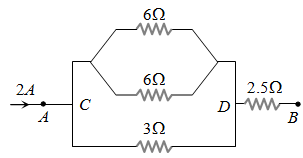
The equivalent resistance and potential difference between A and B for the circuit is respectively
Stars are twinkling due to
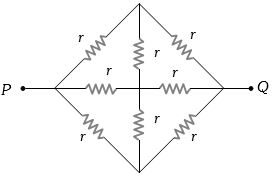
The equivalent resistance between the points $P$ and $Q$ in the network given here is equal to  ................ $\Omega$ (given $r = \frac{3}{2}\Omega $)
In double slit experiment, the wavelength $\lambda $ of the light source $400\ nm$ , the slit seperation $d$ is $20\ \mu m$ and the individual slit width a is $4\ \mu m$ . Consider the interference of the light from the two slits and also the diffraction of light through each slit. Find number bright interference fringes are within the central peak of diffraction envelope
Two non ideal batteries are connected in series. Consider the following statements
$(A)$ The equivalent emf is larger than either of the two emfs.
$(B)$ The equivalent internal resistance is smaller than either of the two internal resistances.
The example of nuclear fusion is
An electric dipole placed in a uniform elecrtric field exepriences:
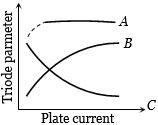
The figure represents variation of triode parameter ($\pi$ or $r_p$ or gm) with the plate current. The correct variation of $\mu$and rp are given, respectively by the curves
Given below are two statements:

Statement $I:$ In a typical transistor, all three regions emitter, base and collector have same doping level.

Statement $II:$ In a transistor, collector is the thickest and base is the thinnest segment.

In the light of the above statements, choose the most appropriate answer from the options given below.