MCQ
How did de – Broglie conclude the modification of Bohr’s II postulate?
  • A
    De – Broglie concluded that electrons cannot be quantized.
  • B
    De – Broglie concluded that the wavelength of electrons should be reduced.
  • C
    De – Broglie concluded that angular momentum cannot be quantized.
  • D
    De – Broglie concluded that wavelengths of matter waves can be quantized.

Answer

  1. De – Broglie concluded that wavelengths of matter waves can be quantized.

Explanation:

de – Broglie concluded his modification of Bohr’s second postulate by stating that the wavelengths of matter waves can be quantized.
This implies that the electrons can exist in those orbits which had a complete set of several wavelengths.

Need a full question paper?

Generate a complete, print-ready paper with questions like this in minutes — across 16+ boards, with answer keys.

Start Generating Free

Similar questions

A capacitor is charged by a battery. The battery is removed, and another identical uncharged capacitor is connected in parallel. The total electrostatic energy of resulting system.

Consider the following statements A and B and identify the correct choice of the given answers

A : The width of the depletion layer in a P-N junction diode increases in forwards bias

B : In an intrinsic semiconductor the fermi energy level is exactly in the middle of the forbidden gap

(a) A is true and B is false

(b) Both A and B are false

(c) A is false and B is true

(d) Both A and B are true

Identify the type of materials which develop electric currents in them, when an electric field is applied.

Through two parallel wires A and B, 10 and 2 ampere of currents are passed respectively in opposite direction. If the wire A is infinitely long and the length of the wire B is 2 m, the force on the conductor B, which is situated at 10 cm distance from A will be

(a) 8  

(a) 8  

(c) 4  

(d) 4π  

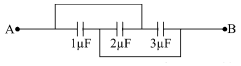
In the attached figure, the value of equivalence between points A and B will be:
Image
Convex lens is not used in:
The electric potential is measured in:

Ultraviolet light of wavelength 300 nm and intensity 1.0 watt/m2 falls on the surface of a photosensitive material. If 1% of the incident photons produce photoelectrons, then the number of photoelectrons emitted from an area of 1.0 cm2  of the surface is nearly

(a) 9.61  per sec

(b) 4.12  per sec

(c) 1.51  per sec

(d) 2.13  per sec

Which of the following can be deflected by applying magnetic field ?

Two ions having masses in the ratio 1 : 1 and charges 1 : 2 are projected into uniform magnetic field perpendicular to the field with speeds in the ratio 2 : 3. The ratio of the radii of circular paths along which the two particles move is

(a) 4 : 3

(b) 2 : 3

(c) 3 : 1

(d) 1 : 4