MCQ
How did de – Broglie modify Bohr’s postulate?
  • A
    De – Broglie suggested to not take angular momentum into consideration.
  • B
    De – Broglie suggested introducing an electric field near the atom.
  • C
    De – Broglie suggested that electrons behaved like a wave.
  • D
    De – Broglie did not modify Bohr’s second postulate.

Answer

  1. De – Broglie suggested that electrons behaved like a wave.

Explanation:

de – Broglie hypothesis did modify Bohr’s second postulate.

This postulate of Bohr regarding the quantization of the angular momentum of an electron was further explained by Louis de Broglie.

According to de – Broglie, a moving electron in its circular orbit behaves like a particle-wave.

Need a full question paper?

Generate a complete, print-ready paper with questions like this in minutes — across 16+ boards, with answer keys.

Start Generating Free

Similar questions

In a cathode ray oscillograph, the focusing of beam on the screen is achieved by:
A constant current of 2.8A exists in a resistor. The rms current is:

n identical condensers are joined in parallel and are charged to potential V. Now they are separated and joined in series. Then the total energy and potential difference of the combination will be

(a) Energy and potential difference remain same

(b) Energy remains same and potential difference is  nV

(c) Energy increases  n times and potential difference is  nV

(d) Energy increases  n times and potential difference remains same

The Young's experiment is performed with the lights of blue (λ = 4360 Å) and green colour (λ = 5460 Å), If the distance of the 4th fringe from the centre is x, then

(a) x (Blue) = x (Green)

(b) x (Blue) > x (Green)

(c) x (Blue) < x (Green)

(d)

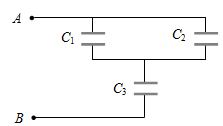
In the given network capacitance,  and . What is the resultant capacitance between A and B

(a) 2.2 μF

(b) 3.2 μF

(c) 1.2 μF   

(d) 4.7 μF

In circuit shown below, the resistances are given in ohms and the battery is assumed ideal with emf equal to 3 volt. The voltage across the resistance R4 is

(a) 0.4 V

(b) 0.6 V

(c) 1.2 V  

(d) 1.5 V

When a forward bias is applied to a p-n juction it ___________ .
A photon of energy hv is absorbed by o free electron of a metal having work function $\varphi<\text{hv}.$
  1. The electron is sure to come out.
  2. The electron is sure to come out with a kinetic energy $\text{hv}-\varphi.$
  3. Either the electron does not come out or it comes out with a kinetic energy $\text{hv}-\varphi$ .
  4. It may come out with a kinetic energy less than $\text{hv}-\varphi.$

What will be the height of image when an object of 2 mm is placed on the axis of a convex mirror at a distance 20 cm of radius of curvature 40 cm

(a) 20 mm

(b) 10 mm

(c) 6 mm

(d) 1 mm

In Young's double slit experiment when wavelength used is 6000 Å and the screen is 40 cm from the slits, the fringes are 0.012 cm wide. What is the distance between the slits

(a) 0.024 cm

(b) 2.4 cm

(c) 0.24 cm

(d) 0.2 cm