Question
How did Dr. Ambedkar strive for upliftment of Dalits?

Answer

Dr B.R. Ambedkar was the first person from their caste to complete his college education and proceed to England to become a lawyer. He made endless efforts to gain entry, for the Dalits, into the temples. Later on in life, he took up Buddhism and converted to Buddhism that treated all men equally. He was elected to the Constituent Assembly from Bengal in November 1946. He became the Chairman of the Drafting Committee in 1947. Later, as Law Minister in the Union Cabinet, he did much for the upliftment of the untouchables. He rightly believed that the Dalits had to come forward and help themselves.

Need a full question paper?

Generate a complete, print-ready paper with questions like this in minutes — across 16+ boards, with answer keys.

Start Generating Free

Similar questions

Explain briefly the caste system in India.
In the Rigveda, people were described in terms of the work they did and the languages they spoke. In the table below, fill in the names of six people you know, choosing three men and three women. For each of them, mention the work they do and the language they speak. Would you like to add anything else to the description?
Discuss in a short paragraph ‘Iron Tools and Agriculture’.
List the advantages of (a) mountains and (b) plateaus.
How does earth’s revolution take place?
What steps has the Indian Government taken to conserve forests in India?
This date is related with the beginning of the Mauryan empire. Question 15. Why are the following dates important?
  1. 327-26 B.C.
  2. 323 B.C.
  3. 321 B.C.
  4. 305 B.C.
  5. 269 B.C.
  6. 260 B.C.
  7. 185 B.C.
Read the following account (terrace farming in Nagaland) and answer the questions that follow it:
Terrace Farming in Nagaland:
This is a village called Chizami which is in Phek district in Nagaland. The people of this village belong to the Chakhesang community. They do ‘terrace’ cultivation.
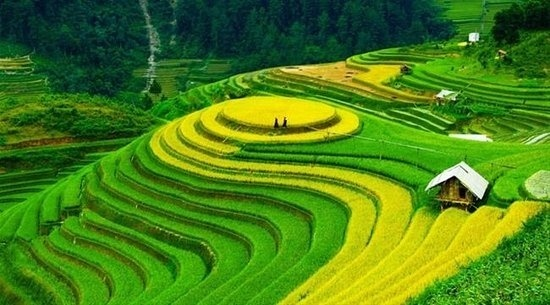
This means that the land on a hill slope is made into flat plots and carved out in steps. The sides of each plot are raised in order to retain water. This allows water to stand in the field, which is best for rice cultivation.
The people of Chizami have their own individual fields. But, they also work collectively in each other’s fields. They form groups of six or eight and take an entire mountainside to clean the weeds on it.
Each group eats together once their work for the day is over. This goes on for several days until the work is completed.
  1. Which village is referred to in the picture above? Where is it located?
  2. Which community do the villagers of this village belong to?
  3. What type of farming do they practise?
  4. For what is this practice the best?
  5. Why do the people of Chizami work collectively?
Why the river plains are thickly populated?
Explain the role of the Chairman and Vice- Chairman of the Panchayat Samiti.