Question
How do atomic radius vary in a period and in a group? How do you explain the variation?

Answer

Atomic radius increases down the group and decreases across the period. This is due to the continuous increase in the number of electronic shells or orbit numbers in the structure of atoms of the elements down the group.
From left to right across a period atomic radii generally decrease due to an increase in effective nuclear charge.

Need a full question paper?

Generate a complete, print-ready paper with questions like this in minutes — across 16+ boards, with answer keys.
Start Generating Free

Similar questions

Justify the following statements.
  1. Reactions with $\Delta\text{G}<0$ always have an equilibrium constant greater than 1.
  2. Many thermodynamically feasible reactions do not occur under ordinary conditions.
  3. At low temperatures, enthalpy change dominates the $\Delta\text{G}$ expression and at high temperatures, it is the entropy which dominates the value of $\Delta\text{G}.$
Explain the following:
  1. Common ion effect.
  2. Bronsted Lowry concepts of acids and bases.
What is the effect of temperature on the reactions? Give reason.
  1. $\text{N}_2\text{(g)+3}\text{H}_2(\text{g})\rightleftharpoons2\text{NH}_3(\text{g})+\text{Heat}$
  2. $\text{N}_2\text{(g)+}\text{O}_2(\text{g})\rightleftharpoons2\text{NO}(\text{g})+\text{Heat}$
Pressure is determined as force per unit area of the surface. The SI unit of pressure, Pascal is as shown below:
1Pa = 1N m–2
If mass of air at sea level is 1034g cm–2, calculate the pressure in Pascal.
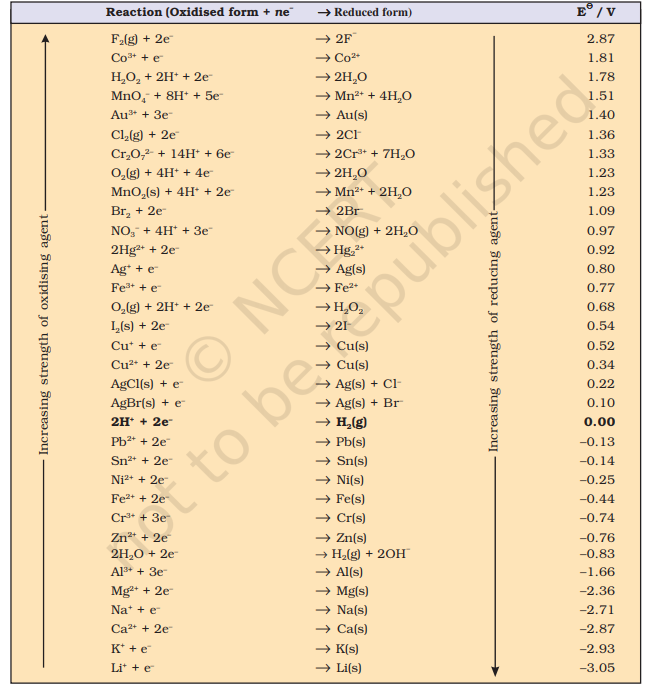
Using the standard electrode potentials given in the Table, predict if the reaction between the following is feasible:

Br2(aq) and Fe2+(aq).
Answer the following questions:
  1. B, Al, Ga arrange in decreasing order of atomic radii.
  2. C, F, O first electron gain enthalpy in increasing order.
  3. Al forms amphoteric oxide, why?
Calculate the concentration of nitric acid in moles per litre in a sample which has a density, $1.41 g mL ^{-1}$ and the mass per cent of nitric acid in it being $69 \%$.
10g of argon is compressed isothermally and reversibly at a temperature of 27°C from 10L to 5L. Calculate q, W, $\Delta\text{U}$ and $\Delta\text{H}$ for this process. R = 2.0cal K-1 mol-1, log2 = 0.30, atomic weight, of Ar = 40.
The solubility of $Sr ( OH )_2$ at 298 K is $19.23 g / L$ of solution. Calculate the concentration of strontium and hydroxyl ions and the pH of the solution.
Name a suitable technique of separation of the components from a mixture of calcium sulphate and camphor.