Question
How do organisms, whether reproduced asexually or sexually maintain a constant chromosome number through several generations? Explain with the help of suitable example.

Answer

In both sexual and asexual reproduction, there is great importance of maintaining a constant number of chromosomes. But the process mechanism is dissimilar in both the type of reproductions.
  1. In case of asexual reproduction, the entire set of chromosomes is replicated and transferred to the next generation. DNA copying is accompanied by the creation of an additional cellular material, after which the DNA copies separate, each with its own cellular apparatus. Effectively, a cell divides to give rise to two cells. Thus, chromosome number remains unchanged.
For example: Replica of Amoeba by binary fission.
  1. In case of sexual reproduction, the chromosome number is halved to form gametes. Then these gametes combine to restore the original chromosome number.
For example: In the case of human beings they have 46 chromosomes present in a cell, during reproduction gametes are generated which include half the number i.e. 23. Now, when female gamete containing 23 chromosomes is combined with male gamete with 23 chromosomes, the number is restored to original 46 (23 + 23).

Need a full question paper?

Generate a complete, print-ready paper with questions like this in minutes — across 16+ boards, with answer keys.
Start Generating Free

Similar questions

Write the name and structural formula of the compound obtained when ethanol is heated at 443 K with excess of cone. $H _2 SO _4$. Also write chemical equation for the reaction stating the role of cone. $H _2 SO _4$ in it.
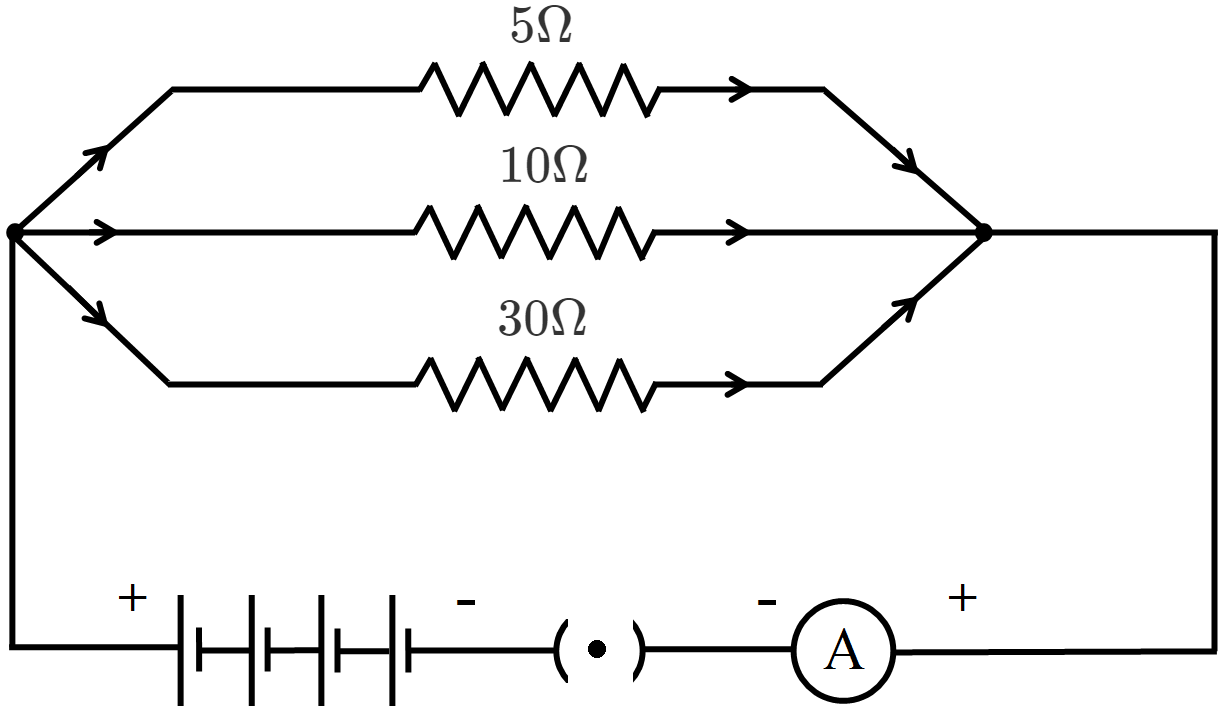
For the circuit shown in the diagram given below:
Calculate:
  1. The value of current through each resistor.
  2. The total current in the circuit.
  3. The total effective resistance of the circuit.
Write the number of periods the Modern Periodic Table has. State the changes in valency and metallic character of elements as we move from left to right in a period. Also state the changes, if any, in the valency and atomic size of elements as we move down a group.
Draw a neat diagram of a flower showing its various parts. In this diagram mark stem, receptacle, sepals, petals, stamen and carpel.
When an object is placed 10cm in front of lens A, the image is real, inverted, magnified and formed at a great distance. When the same object is placed 10cm in front of lens B, the image formed is real, inverted and same size as the object:
  1. What is the focal length of lens A?
  2. What is the focal length of lens B?
  3. What is the nature of lens A?
  4. What is the nature of lens B?
An arrow 2.5cm high is placed at a distance of 25cm from a diverging mirror of focal length 20cm. Find the nature, position and size of the image formed.
QUESTION Using electron-dot diagrams which show only the outermost shell electrons, show how a molecule of oxygen, $O _2$, is formed from two oxygen atoms. What name is given to this type of bonding? (At. No. of oxygen $=8$ )
A solution of potassium chloride when mixed with silver nitrate solution, an insoluble white substance is formed. Write the chemical reaction involved and also mention the type of the chemical reaction?
Given below are some elements of the modern periodic table. Atomic number of the element is given in the parentheses: $A(4), B(9), C(14), D(19), E(20)$
a. Select the element that has one electron in the outermost shell. Also write the electronic configuration of this element.
b. Which two elements amongst these belong to the same group? Give reason for your answer.
c. Which two elements amongst these belong to the same period? Which one of the two has bigger atomic radius?
Why does the size of the atoms progressively become smaller when we move from sodium (Na) to chlorine (Cl) in the third period of the periodic table?