Question
How do you account for (a) positive zero error (b) negative zero error, for calculating correct diameter of wires?
Answer

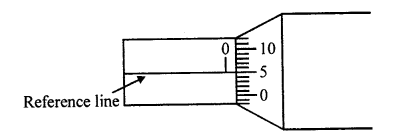
(a) Positive zero error: If the zero line, marked on circular scale, is below the reference line of the main scale, then there is a positive zero error and the correction is negative.
In the figure 5th circular scale division is coinciding with reference line.
$\therefore$ Correction
$=-$ Coinciding division of C.S. $\times$ L.C.
$=-5 \times 0.001 cm=-0.005 cm$
If the observed diameter is 0.557 cm , then:
Corrected diameter
= Observed diameter + Correction
$=0.557 cm-0.005 cm=0.552 cm$
Image
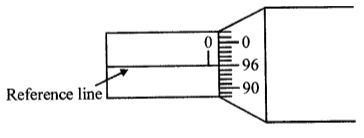
(b) Negative zero error : If the zero line marked on circular scale, is above the reference line of the main scale, then there is a negative error and the correction is positive.
In the figure, there is 96 th division on the circualr scale which coincides with reference line.
$\therefore$ Correction $-+[ n$ - coinciding division of C.S. $\times$ L.C.]
where n is the total number of circular scale divisions.
$\therefore$ Correction $=+[100-96] \times 0.001 cm$
$=0.004 cm$
If observed diameter is 0.557 cm , then :
Corrected diameter
= Observed diameter + Correction
$=0.557 cm+0.004 cm$
$=0.561 cm$
Image

Need a full question paper?

Generate a complete, print-ready paper with questions like this in minutes — across 16+ boards, with answer keys.

Start Generating Free

Similar questions

In the vernier callipers, there are $10$ divisions on the vernier scale and $1 \ cm$ on the main scale is divided into $10$ parts. While measuring the length, the zero of the vernier lies just ahead of the $1.8 \ cm$ mark and the $4th$ division of vernier coincides with a main scale division.
(a) Find the length.
(b) If zero error of vernier callipers is -$0.02 cm,$
What is the correct length ?
(a) What do you understand by the term hydroelectric power?
(b) Explain the energy changes taking place in a hydroelectric dam?
A motor bike running at $90 kmh ^{-1}$, is slowed down to $54 kmh ^{-1}$ by the application of brakes, over a distance of 40 m . If the brakes are applied with the same force, calculate
1. total time in which bike comes to rest
2. total distance travelled by bike.
State briefly, how and why the atmospheric pressure of a place varies with the altitude. Draw an approximate graph to illustrate this variation.
Explain meaning of the terms compression and rarefaction in relation to a longitudinal wave.
A body is held immersed in a liquid. (i) Name the two forces acting on the body and draw a diagram to show these forces. (ii) State how the magnitudes of two forces mentioned in part (i) determine whether the body will float or sink in liquid when it is released. (iii) What is the net force on the body if it (a) sinks and (b) floats?
The following table gives the displacement of a car at different instants of time.
Time (s) 0 1 2 3 4
Displacement (m) 0 5 10 15 20
(a) Draw the displacement-time sketch and find the average velocity of the car. (b) What will be the displacement of the car at (i) 2.5 s and (ii) 4.5 s?
The graph shows how the velocity of a scooter varies with time in 50 s.
Work out: Deceleration
A graph plotted by taking $T ^2$ on the Y -axis and L on the X -axis in an experiment of a simple pendulum is a straight line. What relationship between $T ^2$ and I , does this graph represent?
An object is kept at 60 cm in front of a plane mirror. If the mirror is now moved 25 cm away from the object, how does the image shift from its previous position?