Questions

[5 Mark Question Answer]

🎯

Test yourself on this topic

19 questions · timed · auto-graded

Question 14 Marks
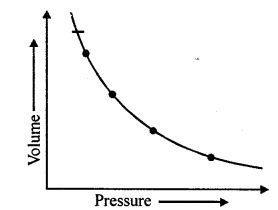
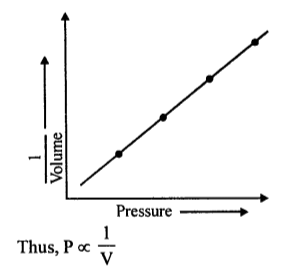
How does a graph help in determining the proportional relationship between two quantities?
View full question & answer
Question 24 Marks
(a) Name the two factors on which time period of a simple pendulum depends.
(b) Name the devices commonly used to measure
(i) mass and
(ii) weight of a body.
View full question & answer
Question 34 Marks
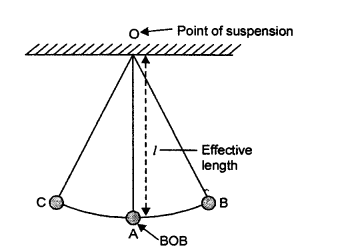
Define the following in connection with a simple pendulum.
(a) Time period
(b) Oscillation
(c) Amplitude
(d) Effective length.
View full question & answer
Question 44 Marks
(a) Define simple pendulum.
(b) State two factors which determine time period of a simple pendulum.
(c) Write an expression for the time period of a simple pendulum.
View full question & answer
Question 54 Marks
How do you account for (a) positive zero error (b) negative zero error, for calculating correct diameter of wires?
Answer
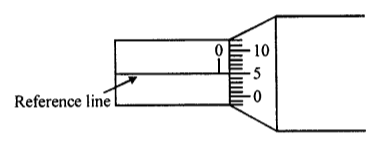
(a) Positive zero error: If the zero line, marked on circular scale, is below the reference line of the main scale, then there is a positive zero error and the correction is negative.
In the figure 5th circular scale division is coinciding with reference line.
$\therefore$ Correction
$=-$ Coinciding division of C.S. $\times$ L.C.
$=-5 \times 0.001 cm=-0.005 cm$
If the observed diameter is 0.557 cm , then:
Corrected diameter
= Observed diameter + Correction
$=0.557 cm-0.005 cm=0.552 cm$
Image
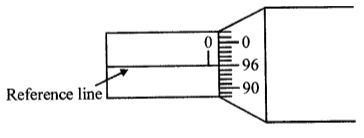
(b) Negative zero error : If the zero line marked on circular scale, is above the reference line of the main scale, then there is a negative error and the correction is positive.
In the figure, there is 96 th division on the circualr scale which coincides with reference line.
$\therefore$ Correction $-+[ n$ - coinciding division of C.S. $\times$ L.C.]
where n is the total number of circular scale divisions.
$\therefore$ Correction $=+[100-96] \times 0.001 cm$
$=0.004 cm$
If observed diameter is 0.557 cm , then :
Corrected diameter
= Observed diameter + Correction
$=0.557 cm+0.004 cm$
$=0.561 cm$
Image
View full question & answer
Question 64 Marks
What do you understand by the following terms as applied to screw gauge?
(a) Zero error
(b) Positive zero error
(c) Negative zero error.
Answer
(a) Zero error: If the zero of the main scale does not coincide with zero of circular scale on bringing the screw end in contact with the stud, the screw gauge is said to have zero error.
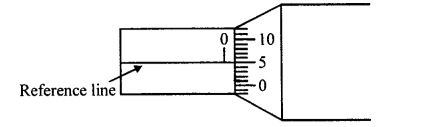
(b) Positive zero error : If the zero of the circular scale is below the reference line of the main scale, then screw gauge is said to have positive zero error and the correction is negative.
Image
(c) Negative zero error : If the zero of the circular scale is above the reference line of the main scale, then screw gauge is said to have negative zero error and correction is positive.
Image
View full question & answer
Question 74 Marks
What do you understand by the following terms as applied to micrometre screw gauge?
1. Sleeve cylinder
2. Sleeve scale
3. Thimble
4. Thimble scale
5. Base line.
Answer
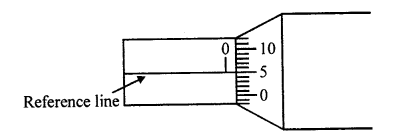
1. Sleeve cylinder : A hollow cylinder attached to a nut of the screw gauge is known as sleeve cylinder.
The spindle of the screw passes through sleeve cylinder
2. Sleeve scale: It is also known as main scale. A reference line or base line graduated in mm , drawn on the sleeve cylinder, parallel to axis of nut is known as sleeve scale.
3. Thimble: A hollow circular cylinder connected to the screw, which rotates along with nut on turning, is called thimble.
4. Thimble scale: It is also known as circular scale. A scale marked on tapered end of a hollow cylinder, which can move over the sleeve cylinder, is known as thimble scale.
5. Base line: A reference line drawn on the sleeve cylinder parallel to the axis of nut is known as base line.
View full question & answer
Question 84 Marks
A micrometre screw gauge has a negative zero error of 7 divisions. While measuring the diameter of a wire the reading on main scale is 2 divisions and 79th circular scale division coincides with base line.
If the number of divisions on main scale is 10 to a centimetre and circular scale has 100 divisions, calculate
1. pitch
2. observed diameter
3. least count
4. corrected diameter.
Answer
(i) The number of divisions on the main scale are 10 to a centimetre
$
\Rightarrow \text { Pitch }=\frac{\text { Unit }}{\text { No. of divisions in unit }}=\frac{1 cm}{10}=0.1 cm
$
(ii) No. of circular scale divisions $=100$
$
\begin{array}{l}
\therefore \text { Least count (L.C.) }=\frac{\text { Pitch }}{\text { No. of circular scale divisions }} \\
\quad=\frac{0.1}{100} cm=0.001 cm
\end{array}
$
(iii) Main scale reading $=2$ division
$\Rightarrow$ Main scale reading $=2 \times$ Pitch $=0.2 cm$
Circular scale reading $=79$ division
$\therefore$ Observed diameter $=$ M.S. reading + L.C. $\times$ C.S. reading
$
\begin{array}{l}
=0.2+0.001 \times 79 \\
=0.2+0.079 cm=0.279 cm
\end{array}
$
(iv) Negative zero error $=7$ division
$
\begin{array}{l}
\therefore \text { Correct }=-(-7 \times \text { L.C. }) \\
\quad=-(-7 \times 0.001)=+0.007 cm
\end{array}
$
Corrected diameter $=$ Observed diameter + Correction
$
=0.279+0.007=0.286 cm
$
View full question & answer
Question 94 Marks
A micrometre screw gauge has a negative zero error of 8 divisions. While measuring the diameter of a wire the reading on main scale is 3 divisions and 24th circular scale division coincides with base line.
If the number of divisions on the main scale are 20 to a centimetre and circular scale has 50 divisions, calculate
1. pitch
2. observed diameter.
3. least count
4. corrected diameter.
Answer
(i) The number of divisions on the main scale are 20 to a centimetre
$
\Rightarrow \text { Pitch }=\frac{\text { Unit }}{\text { No. of divisions in unit }}=\frac{1 cm}{20}=0.05 cm
$
(ii) No. of circular scale divisions $=50$
$
\begin{array}{l}
\therefore \text { Least count (L.C.) }=\frac{\text { Pitch }}{\text { No. of circular scale divisions }} \\
\quad=\frac{0.05}{50} cm \\
\text { L.C. }=0.001 cm
\end{array}
$
(iii) Main scale reading $=3$ division
$\Rightarrow$ Main scale reading $=3 \times$ Pitch $=3 \times 0.05=0.15 cm$
Circular scale reading $=24$ division
$\therefore$ Observed diameter $=$ M.S. reading + L.C. $\times$ C.S. reading
$
\begin{array}{l}
=0.15+0.001 \times 24 \\
=0.15+0.024=0.174 cm
\end{array}
$
(iv) Negative zero error $=8$ division
Correction $=-(-8 \times$ L.C. $)$
$
=-(-8 \times 0.001) cm=+0.008 cm
$
Correct diameter $=$ Observed diameter + Correction
$
=0.174+0.008=0.182 cm
$
View full question & answer
Question 104 Marks
The thimble of a screw gauge has 50 divisions for one rotation. The spindle advances 1 mm when the screw is turned through two rotations.
1. What is the pitch of screw?
2. What is the least count of screw gauge?
3. When the screw gauge is used to measure the diameter of wire the reading on sleeve is found to be 0.5 mm and reading on thimble is found 27 divisions. What is the diameter of wire in centimetres?
View full question & answer
Question 114 Marks
A micrometre screw gauge having a positive zero error of 5 divisions is used to measure diameter of wire, when reading on main scale is 3rd division and 48th circular scale division coincides with base line. If the micrometer has 10 divisions to a centimetre on main scale and 100 divisions on circular scale, calculate
1. Pitch of screw
2. Least count of screw
3. Observed diameter
4. Corrected diameter.
View full question & answer
Question 124 Marks
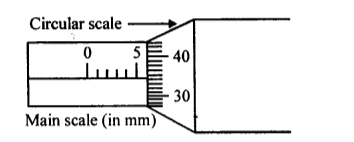
Figure shows a screw gauge in which circular scale has 200 divisions. Calculate the least count and radius of wire.
Image
Answer
No. of circular scale divisions $=200$
Pitch = 1 mm
$
\begin{array}{l}
\text { Least count (L.C.) }=\frac{\text { Pitch }}{\text { No. of circular divisions }} \\
=\frac{1 mm}{200}=0.005 mm
\end{array}
$
L.C. $=0.0005 cm$
Main scale reading $=5 mm=0.5 cm$
(C.S.D.) circular scale reading $=34$ divisions
Observed diameter of wire $=$ Main scale reading + L.C. $\times$ C.S.D.
$
\begin{array}{l}
=0.5+0.0005 \times 34 \\
=0.5+0.0170=0.5170 cm
\end{array}
$
$
\text { Radius of wire }=\frac{\text { diameter }}{2}=\frac{0.5170}{2}=0.2585 cm
$
View full question & answer
Question 134 Marks
(a) What do you understand by the term zero error?
(b) When does a vernier callipers has
1. positive error
2. negative error?
(c) State the correction if
1. positive error is 7 divisions
2. negative error is 7 divisions, when the least count is 0.01 cm .
Answer
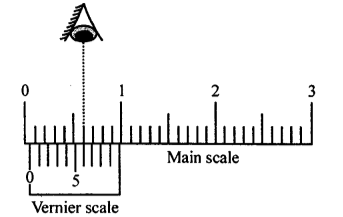
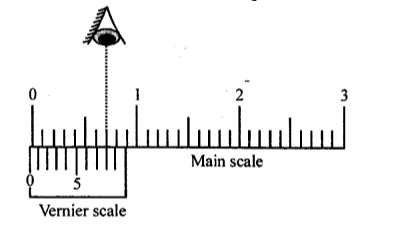
(a) Zero Error : A vernier callipers is said to have a zero error when zero of the main scale does not coincide with zero of vernier scale.
(b) Positive Error : If the zero of the vernier scale is on right hand side of zero of the main scale, then error is said to be positive and correction is said to be negative.
Image
Negative Error : If the zero of the vernier scale is on the left hand side of zero of the main scale, the error is said be negative and the correction is said to be positive.
Image
(c) When positive error is 7 divisions and L.C. is 0.01 cm Then correction $=-(+7 \times$ L.C. $)$
$
=-7 \times 0.01 cm=-0.07 cm
$
When negative error is 7 divisions and count (L.C.) is 0.01 cm
$
\text { Then correction }=-(-7 \times \text { L.C. })
$
$
=-(-7 \times 0.01) cm=+0.07 cm
$
View full question & answer
Question 144 Marks
(a) A vernier scale has 10 divisions. It slides over a main scale, whose pitch is 1.0 mm. If the number of divisions on the left hand of zero of the vernier scale on the main scale is 56 and the 8th vernier scale division coincides with the main scale, calculate the length in centimetres.
(b) If the above instrument has a negative error of 0.07 cm, calculate corrected length.
Answer
No. of divisions on vernier scale $=10$
Pitch $=1.0 mm$
$\begin{array}{l} \text { Pitch }=\frac{\text { Pitch }}{\text { No. of divisions on the vernier scale }} \\
\text { L.C. }=\frac{1.0}{10} mm \\
\text { L.C. }=0.1 mm \\
\text { L.C. }=0.01 cm
\end{array}
$
There are 56 number of main scale division on the left hand of zero of the vernier scale.
$\Rightarrow$ Main scale reading $=56 mm=5.6 cm$
Vernier scale reading coinciding with main scale $=8$ th
(a) Length recorded $=$ Main scale reading + L.C. $\times$ V.S.D.$
=5.6+0.01 \times 8=5.6+0.08=5.68 cm$
(b) Negative error $=-0.07 cm$$\Rightarrow \text { Correction }=-(-0.07)=+0.07 cm$
$\therefore$ Corrected length $=$ Observed reading + Correction$
=5.68+(+0.07)=5.68+0.07=5.75 cm$
View full question & answer
Question 154 Marks
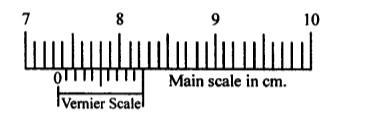
In figure for vernier callipers, calculate the length recorded.
Image
Answer
$
\begin{array}{l}
\text { Main scale divisions of vernier callipers in one centimetre }=10\\
\begin{array}{l}
\begin{aligned}
\text { Pitch } & =\frac{\text { Unit of main scale }}{\text { Number of divisions in the unit }} \\
& =\frac{1}{10} cm=0.1 cm
\end{aligned} \\
\text { Least count (L.C.) }=\frac{\text { Pitch }}{\text { No. of divisions on the vernier scale }} \\
\qquad \text { L.C. }=\frac{0.1}{10} cm=0.01 cm \\
\text { Here main scale reading }=7.3 cm \\
\text { Vernier scale reading (V.S.D.) coinciding with main scale }=5 \text { th } \\
\text { Length recorded }=\text { Main scale reading }+ \text { L.C. } \times \text { V.S.D. } \\
\quad=7.3+0.01 \times 5=7.3+0.05=7.35 cm
\end{array}
\end{array}
$
View full question & answer
Question 164 Marks
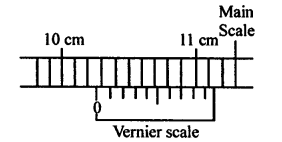
Figure shows the position of vernier scale, while measuring the external length of a wooden cylinder.
1.What is the length recorded by main scale?
Image
2.Which reading of vernier scale coincides with main scale?
3.Calculate the length.
Answer
Main scale divisions of vernier callipers in one centimetre $=10$
$
\begin{aligned}
\text { Pitch } & =\frac{\text { Unit of main scale }}{\text { Number of divisions in the unit }} \\
& =\frac{1}{10} cm=0.1 cm
\end{aligned}
$
$
\text { Least count }=\frac{\text { Pitch }}{\text { No. of divisions on the vernier scale }}
$
$
\text { L.C. }=\frac{0.1}{10} cm=0.01 cm
$
(i) Length recorded by main scale $=10.2 cm$
$\Rightarrow$ Main scale reading is 10.2 cm
(ii) Reading of vernier scale coinciding with main scale $=7$ th
$\Rightarrow$ Vernier scale division (V.S.D.) is 7th
(ii) Length recorded by vernier callipers
$
\begin{array}{l}
=\text { Main scale reading }+ \text { L.C. } \times \text { V.S.D. } \\
=10.2+0.01 \times 7=10.2+0.07=10.27 cm
\end{array}
$
View full question & answer
Question 174 Marks
(a) State the formula for calculating percentage error
(b) Is it possible to increase the degree of accuracy by mathematical manipulations? Support your answer by an example.
Answer
(a) The percentage error can be calculated by the formula :
$
\text { Percentage error }=\frac{\text { Absolute error }}{\text { Actual value }} \times 100
$
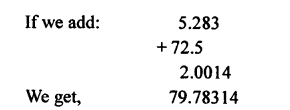
(b) It is not possible to increase the degree of accuracy by mathematical manipulations. For examples: When a number of values are added or subtracted, the result cannot be more accurate than the least accurate value.
Image
In the above addition 72.5 has least accuracy. When we . say 72.5, it implies that value lies between 72.45 and 72.55 and 72.5 is the most probable value. Thus the error in 72.5 is +0.05. As the final result cannot be more accurate than least accurate observation, so the correct and most reliable answer in the above addition is 72.9.
View full question & answer
Question 184 Marks
(a) Define time.
(b) State or define the following terms:
1. Solar day
2. Mean solar day
3. An hour
4. Minute
5. Second
6 . Year.
Answer
(a) Time : It is defined as the time interval between two events
(b)
(i) Solar day: The time taken by the earth to complete one rotation about its own axis is called solar day.
(ii) Mean solar day : The average of the varying solar days, when the earth completes one revolution around the sun, is called mean solar day.
(iii) An hour : It is defined as the $1 / 24$ th part of the mean solar day.
(iv) Minute : It is defined as the $1 / 1440$ part of the mean solar day.
(v) Second : "A second is defined as $1 / 86400$ th part of a mean solar day."
OR
Second may also be defined "as to be equal to the duration of9,192,631,770 vibrations corresponding to the transition between two hyperfme levels of caesium - 133 atom in the ground state."
(vi) Year : One year is defined as the time in which earth completes one complete revolution around the sun.
View full question & answer
Question 194 Marks
What do you understand by the term derived unit? Give three examples.
View full question & answer
[5 Mark Question Answer] - PHYSICS STD 9 Questions - Vidyadip