Question
The equation for the vibration of a string, fixed at both ends vibrating in its third harmonic, is given by$\text{y}=(0.4\text{cm})\sin\big[(0.314\text{cm}^{-1})\text{x}\big]\cos\big[(600\pi\text{s}^{-1})\text{t}\big]$
  1. What is the frequency of vibration?
  2. What are the positions of the nodes?
  3. What is the length of the string?
  4. What is the wavelength and the speed of two travelling waves that can interfere to give this vibration ?
Answer

The stationary wave equation is given by$\text{y}(0.4\text{cm})\sin\big[(0.314\text{cm}^{-1})\text{x}\big]\cos\big[(600\pi\text{s}^{-1})\text{t}\big]$
  1. $\omega=600\pi\Rightarrow2\pi\text{f}=600\pi\Rightarrow\text{f}=300\text{Hz}$
Wavelength,, $\lambda=\frac{2\pi}{0.314}=\frac{(2\times3.14)}{0.314}=20\text{cm}$
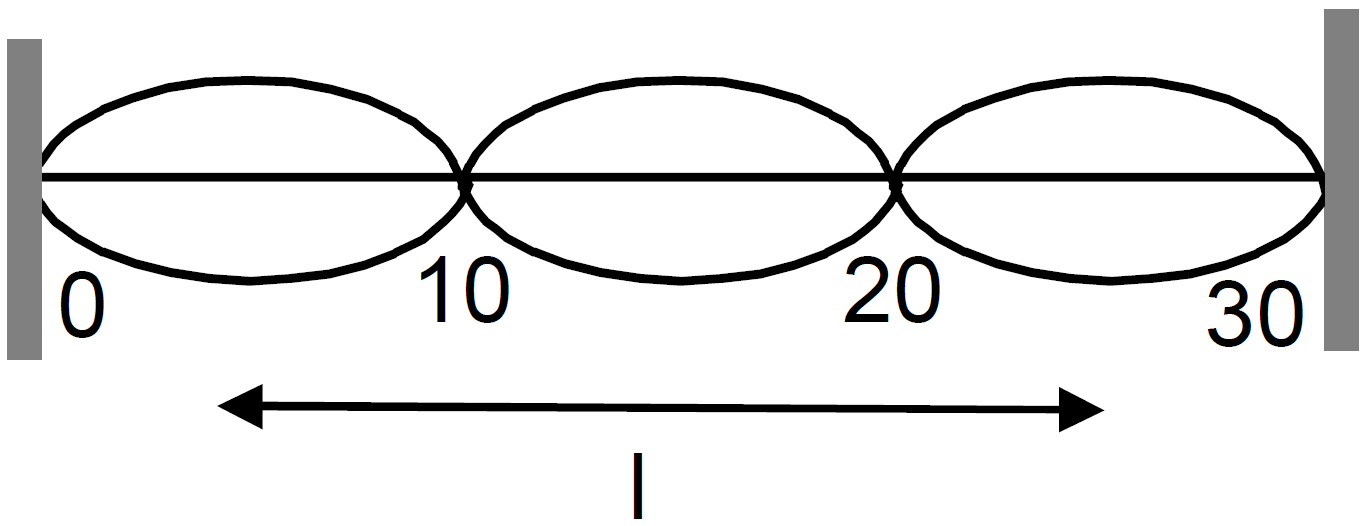
  1. Therefore nodes are located at, $0,\ 10\text{cm},\ 20\text{cm},\ 30\text{cm}$
  2. Length of the string $=\frac{3\lambda}{2}=3\times\frac{20}{2}=30\text{cm}$
  3. $\text{y}=0.4\sin(0.314\text{x})\cos(600\pi\text{t})$
$\Rightarrow0.4\sin\Big\{\big(\frac{\pi}{10}\big)\text{x}\Big\}\cos(600\pi\text{t})$
since $\lambda$ and v are the wavelength and velocity of the waves that interfere to give this vibration $\lambda=20\text{cm}$
$\text{v}=\frac{\omega}{\text{k}}=6000\text{cm/sec}=60\text{m/s}$

Need a full question paper?

Generate a complete, print-ready paper with questions like this in minutes — across 16+ boards, with answer keys.

Start Generating Free

Similar questions


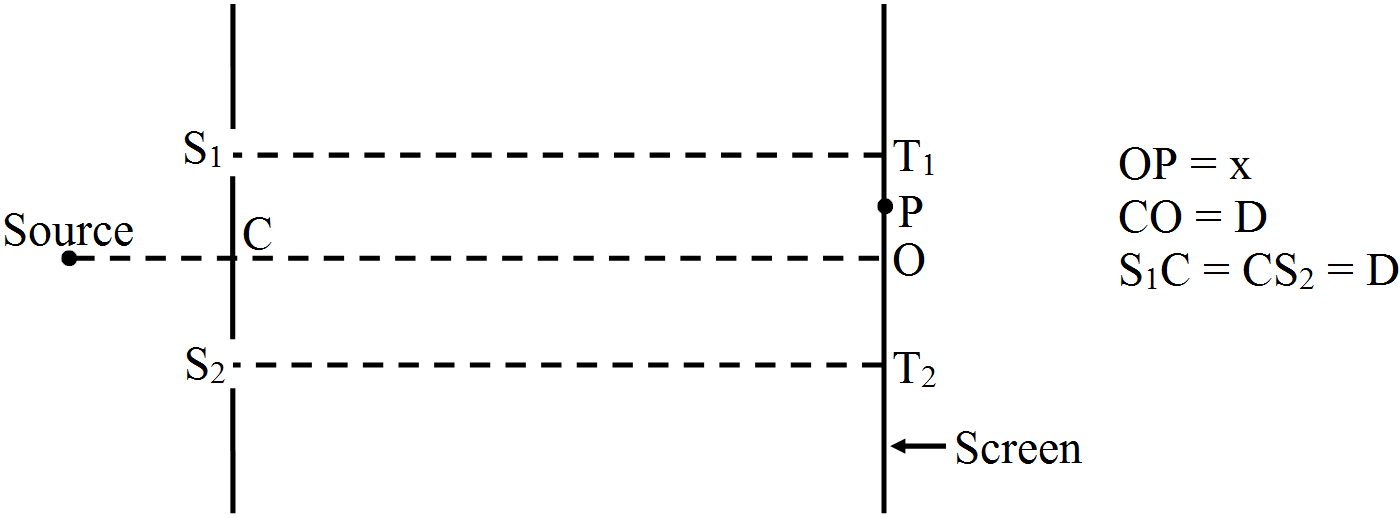
Consider a two slit interference arrangements such that the distance of the screen from the slits is half the distance between the slits.

Obtain the value of D in terms of $\lambda$ such that the first minima on the screen fall at a distance D from the centre O.
Define the current sensitivity of a galvanometer. Write its $SI$ unit.
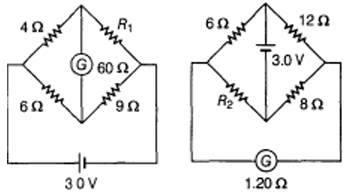
Figure shows two circuits each having a galvanometer and a battery of $3 V $.
When the galvanometer in each arrangement do not show any deflection, obtain the ratio $R_1 / R_2$.
Image
Explain the phenomenon of nuclear fission.
A coil of resistance $100\Omega$ is connected across a battery of emf 6.0V. Assume that the heat developed in the coil is used to raise its temperature. If the heat capacity of the coil is 4.0J/K, how long will it take to raise the temperature of the coil by 15°C?
A charge Q is uniformly distributed over a rod of length l. Consider a hypothetical cube of edge l with the centre of the cube at one end of the rod. Find the minimum possible flux of the electric field through the entire surface of the cube.
A particle of mass m moves on a straight line with its velocity varying with the distance travelled according to the equation $\text{v}=\text{a}\sqrt{\text{x}},$ where a is a constant. Find the total work done by all the forces during a displacement from x = 0 to x = d.
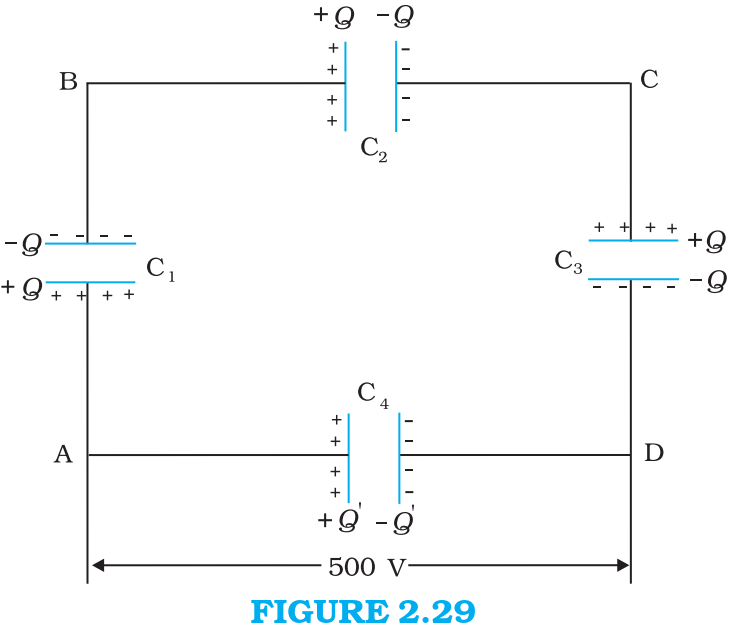
A network of four $10 \mu F$ capacitors is connected to a $500 V$ supply, as shown in Fig. $2.29.$ Determine $(a)$ the equivalent capacitance of the network and $(b)$ the charge on each capacitor. $($Note, the charge on a capacitor is the charge on the plate with higher potential, equal and opposite to the charge on the plate with lower potential.$)$
Image
A long straight wire in the horizontal plane carries a current of 50 A in north to south direction. Give the magnitude and direction of B at a point 2.5 m east of the wire.
A point source emitting light uniformly in all directions is placed 60cm above a table-top. The illuminance at a point on the table-top, directly below the source, is 15 lux. Find the illuminance at a point on the table-top 80cm away from the first point.
  1. Derive the relation between the decay constant and half life of a radioactive substance.
  2. A radioactive element reduces to 25% of its initial mass in 1000 years. Find its half life.