Question
How does a charge q oscillating at certain frequency produce electromagnetic waves?

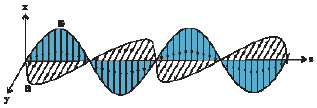
Sketch a schematic diagram depicting electric and magnetic fields for an electromagnetic wave propagating along the Z-direction.

Answer

Oscillating charge produces an oscillating electric field in space, which produces an oscillating magnetic field, which in turn, is a source of oscillating electric field, and so on.

Alternate Answer

An oscillating electric charge produces self sustaining oscillations of electric and magnetic field in free space or vacuum.
Need a full question paper?

Generate a complete, print-ready paper with questions like this in minutes — across 16+ boards, with answer keys.
Start Generating Free

Similar questions

A voltmeter consists of a $25\Omega$ coil connected in series with a $575\Omega$ resistor. The coil takes 10mA for full scale deflection. What maximum potential difference can be measured by this voltmeter?
Explain how does the polarized dielectric modify the original external field inside it ?
Distinguish between polarised and unpolarized light. Does the intensity of polarised light emitted by a Polaroid depend on its orientation? Explain briefly.
The vibrations in a beam of polarised light make an angle of 60° with the axis of the polaroid sheet. What percentage of light is transmitted through the sheet?
Calculate the energy in fusion reaction:
$^{2}_{1}\text{H} + ^{2}_{1}\text{H}\rightarrow^{3}_{2}\text{H}+ \text{n}, \text{where BE}\text{ of} ^{ 2}_{1}\text{H} = 2.23 \text{MeV} \text{and} \text{of} ^{3}_{2}\text{He} = 7.73 \text{MeV}.$
Explain electricity conduction in intrinsic semi-conductors.
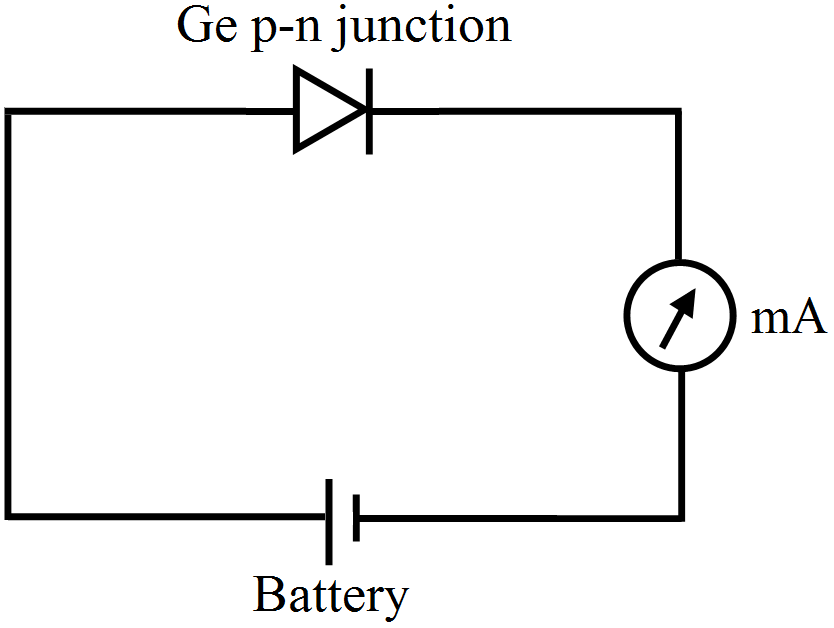
A germanium p-n junction is connected to a battery with milliammeter in series. What should be the minimum voltage of battery so that current may flow in the circuit?

Why does a phonograph-record attract dust particles just after it is cleaned?
Let $\vec{\text{a}}=2\vec{\text{i}}+3\vec{\text{j}}+4\vec{\text{k}}$ and $\vec{\text{b}}=3\vec{\text{i}}+4\vec{\text{j}}+5\vec{\text{k}}.$ Find the angle between them.
Let $\vec{\text{A}}=3\vec{\text{i}}+4\vec{\text{j}}.$ Write four vector $\overrightarrow{\text{B}}$ such that $\overrightarrow{\text{A}}\neq\overrightarrow{\text{B}}$ but A = B.
What is the resistance of an intrinsic semiconductor at 0K?