Question
How does a convex lens act as a ‘converging lens’?
Answer


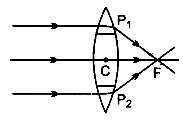
Convex lens may be considered as being made of a large number of prisms, such that in its upper half, prisms have their bases downwards and in its lower half, the prisms have their bases upwards, Due to this, the upper half part deviates the rays of light downwards and the lower half deviates the rays of light upwards while the central part of the lens acts as a glass block allowing the light to pass undeviated. So, any parallel beam of light incident on it converges to a point F.

Need a full question paper?

Generate a complete, print-ready paper with questions like this in minutes — across 16+ boards, with answer keys.
Start Generating Free

Similar questions

Explain with the aid of a simple diagram, the transmission of electric power from the generating station to your house.
Calculate the total amount of heat energy required to convert $100 g$ of ice at $-10^{\circ} C$ completely into water at $100^{\circ} C$. Specific heat capacity of ice $=2.1 kg ^{-1} K ^{-1}$, specific heat capacity of water $=$ 4.2 $Jkg ^{-1} K ^{-1}$, specific latent heat of ice $=336 Jg ^{-1}$
Illustrate-combination of cells e.g., three cells, in series, explaining the combination briefly. Obtain an expression for current ‘i’ in the combination.
State two dis-similarities and one similarity between a d.c. motor and an a.c. generator.
A certain nucleus X has a mass number 15 and atomic number 7. Find the number of neutrons. The nucleus X losses one proton and Express the change and write the symbol of the new nucleus.
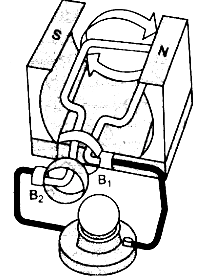
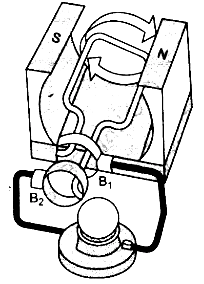
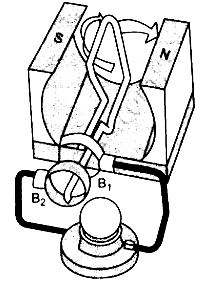
The given figures $1$ to $3$ show the working of a simple $A.C$. generator. Study the diagrams and answers of the following questions.


(i) State and explain the principle underlying the working of a simple generator.
(ii) Where is the loop of wire placed?
(iii) What happens when the loop is rotated?
(iv) Indicate the direction of the current flow through the wire for the first half of the turn (in first figure). Name and state the rule used in finding the direction of the current.
(v) Indicate the direction of the current for the case shown in second figure.
(vi) Indicate the direction of current in the outer circuit (i.e., electric bulb) in first and third figure.
(vii) What type of current is shown in the above diagrams? Explain.
(a) Write one nuclear fusion reaction.

(b) State the approximate value of energy released in the reaction mentioned in part (a).

(c) Give reason for the release of energy stated in part (b).

Explain free and forced vibrations. Give an experimental arrangement to illustrate the phenomenon of resonance.
How would you connect two resistors in series? Draw a diagram. Calculate the total equivalent resistance.
 A lead bullet moving at $70 ms^{-1}$ is brought to rest on hitting a target. If $80 \%$ of its energy is converted into heat energy, find the rise in temperature ( Sp . Heat cap. Of lead is $140 J / kgK$ ).