Questions

[5 Mark Question Answer]

🎯

Test yourself on this topic

12 questions · timed · auto-graded

Question 15 Marks
If there is a convex lens of focal length 75 cm and a concave lens of focal length 40 cm, then calculate their combined power and combined focal length.
Answer
Power of convex lens $=\frac{100}{ f ( cm )}$
$=\frac{100}{75}=+1.33 D$.
Power of concave lens $=\frac{100}{ f ( cm )}$
$=\frac{100}{40}=-2.5 D$.
Their combined power P = + 1.33 D + (− 2.5 D)
P = − 1.17 D.
Their combined focal length $F=\frac{100}{P}=\frac{100}{-1.17}$
F = − 85.47 cm.
Negative sign indicates that the nature of their combination is concave.
View full question & answer
Question 25 Marks
Why do we say that the ‘2F’ and ‘F’ points of a convex lens can be regarded as a sort of ‘turning points’ as far as the nature of the image formed by it is concerned?
Answer
We know that:
(i) When an object is beyond the 2F point of a convex lens, the image formed by it is real, inverted, and diminished in size.
(ii) When the object is in between the ‘2F’ and ‘F’ points of the convex lens, the image formed by it is real, inverted, and enlarged.
(iii) When the object is between the ‘F’ point and the optical centre of the convex lens, the image formed by it is virtual, erect, and enlarged.
We thus notice that there is a sudden change in the nature of the image formed when an object approaching from infinity, crosses the ‘2F’ and ‘F’ points of a convex lens. It is for this reason that we regard these two points as a sort of turning point as far as the nature of the image formed by a convex lens is concerned.
View full question & answer
Question 35 Marks
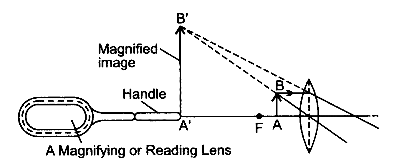
Draw a neat diagram to explain the action of a convergent (convex) lens as a reading glass (or magnifying glass). State the characteristics of the image formed.
Answer

The object to be seen must be placed from the convex lens at a distance less than its focal length.
Characteristics of the image so formed are:
(i) It is virtual and upright.
(ii) It is magnified.
(iii) The image is formed towards the object side.
View full question & answer
Question 45 Marks
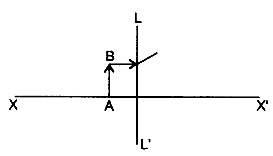
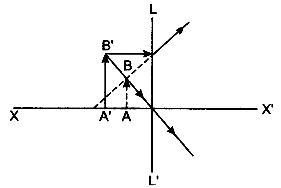
Complete the diagram to show the formation of the image of the object AB.

(i) Name the Lens LL’.
(ii) Where is the image of the object AB formed?
(iii) State three characteristics of the image.
Answer
(i) The lens is a diverging (or concave) lens. (ii) The image of the objects is A’B’ which is formed between the optical centre and focus of the lens, in front of it. (iii) The image is (a) virtual, (b) upright, and (c) diminished.
View full question & answer
Question 55 Marks
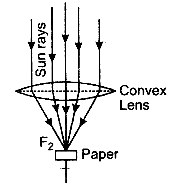
Can one bum a piece of paper in daylight by just using a convex lens instead of a match or any direct flame? Support your answer with the help of an appropriate ray diagram.
Answer
Yes, it is possible to burn a piece of paper, in daylight, by using a convex lens instead of a match or any other direct flame.

We know that a convex lens brings a beam of parallel incident rays to a focus at its focal point. The rays of the sun (practically an infinite distance source) form a parallel incident beam. When they are allowed to fall on a convex lens, they get focussed at its focal point. If a piece of paper is kept at this focal point, all the (large) heat energy of this parallel beam gets concentrated at this point. This (concentrated heat energy) is often sufficient to burn the piece of paper. The required ray diagram is as shown in the figure.
View full question & answer
Question 65 Marks
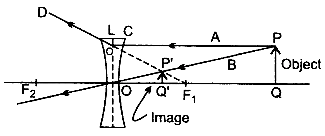
Draw images in case of a concave lens when the object is at any point on the principal axis between the lens and infinity.
Answer
Here the object AB is between the concave lens L and infinity and is at the principal axis. Two incident rays A and B are taken, A after refraction goes in the direction CD while the other ray B goes straight through the optical centre O. DC’ when produced backward meets the ray B at P’, which is the virtual image of P’Q’ is the image of the object PQ. The image is virtual, upright, and diminished and is on the side of the object PQ.
View full question & answer
Question 75 Marks
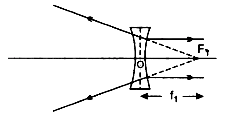
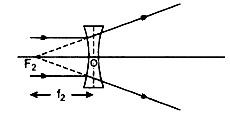
Define the term principal foci as applied to a concave lens. Illustrate your answer with the aid of proper diagrams. Show the focal length of the lens in the diagram.
Answer
A concave lens has two principal foci:
(i) first focus and
(ii) second focus.
(i) First focus: First focus of a concave lens is point $F_1$ on the principal axis of the lens such that the rays of light appearing to meet at it, after refraction from the lens becomes parallel to the principal axis. This is shown in the figure. The distance of first point $F_1$ from the optical centre $O$ of the lens (i.e., $OF_1​​​​​​​$​​​​​​​) is the first focal length $f_1.​​​​​​​$​​​​​​​

(ii) Second focus: Second focus of a concave lens is the point $F_2$ on the principal axis of the lens such that the rays of light incident parallel to the principal axis of the lens after refraction from the lens appears to be coming from it. This is shown in the figure. The distance of the second focal point $F _2$ from the optical centre O of the lens (i.e., $OF _2$ ) is called the second focal length $f_2$.
View full question & answer
Question 85 Marks
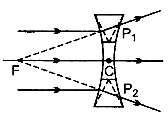
How does a concave lens act as a ‘diverging lens’?
Answer

In a concave lens, the upper half of the lens has the bases of the prisms upwards and the lower half of the lens has the bases of the prisms downwards. Therefore in this lens, the rays of light suffer divergence in the upwards direction, and in the lower half, the rays diverge in the downward direction. On being produced backward by dotted lines, these rays appear to diverge from a point F.
View full question & answer
Question 95 Marks
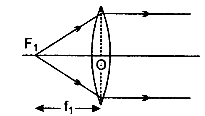
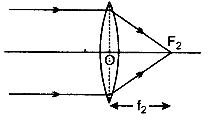
Define the terms principal foci and focal lengths as applied to a convex lens, and show them with the help of proper diagrams.
Answer
A convex lens has two principal foci:
(i) first focus, and
(ii) second focus.
First focus: First focus of a convex lens is a point $F1$ on the principal axis of the lens such that the rays of light starting from it after refraction from the lens become parallel to the principal axis. This is shown in figure. The distance of the first focal point Fj from the optical centre O is called first focal length. In the figure, it has been labelled by $f1$ (i.e., $OF1 = f1)$

Second focus: Second focus of a convex lens is a point $F_2$ on the principal axis of the lens such that the rays of light incident parallel to the principal axis of the lens after refraction from the lens passes through it. This is shown in figure. The distance of the second focal point $F_2$ from the optical centre $O$ is called the second focal length. In the figure, it has been labelled by $f_2$ (i.e., $O F_2=f_2$ ).
View full question & answer
Question 105 Marks
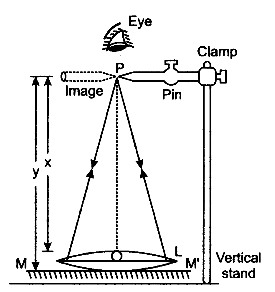
How will you determine the focal length of a convex lens by the plane mirror method?
Answer

Set-up the apparatus as shown in the figure. M is a rectangular sheet of plane mirror fixed in a vertical position in a stand and convex lens L is mounted on a lens stand. P is a pin, set up vertically in a pin stand. Mirror M is placed at the back of the lens. Now the pin P is adjusted by moving it backward and forward so that a real and inverted image of the pin is formed after reflection from the plane mirror M. The position of the pin is carefully adjusted so that there is no parallax between the upper tip of the pin and its inverted image. The distance between the needle and the lens gives the focal length of the lens. In this position rays of light starting from the tip of the pingo parallel to the principal axis and strike the reflecting surface of the mirror M normally. The parallel beam of light is reflected back along the same path and forms the image P‘ of the tip P at the focus of the lens.
View full question & answer
Question 115 Marks
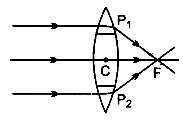
How does a convex lens act as a ‘converging lens’?
Answer

Convex lens may be considered as being made of a large number of prisms, such that in its upper half, prisms have their bases downwards and in its lower half, the prisms have their bases upwards, Due to this, the upper half part deviates the rays of light downwards and the lower half deviates the rays of light upwards while the central part of the lens acts as a glass block allowing the light to pass undeviated. So, any parallel beam of light incident on it converges to a point F.
View full question & answer
Question 125 Marks
An object 5 cm high is held 25 cm away from a converging lens of focal length f = 10 cm. Draw a suitable scale diagram and find the position and size of me image formed is the image real or virtual?
Answer
First of all, draw a horizontal line to represent the principal axis of the convex lens. A convex lens is then drawn with its optical centre C on the axis. The (centre line) aperture of the convex lens has been shown by the line DE. We assume that the refraction of light takes place at the aperture. The focal length of this lens is 2 cm, so we mark its two focal F’ and F at a distance of 2 cm on both the sides of the lens. And to represent the object, we draw an arrow AB, 1 cm high at a distance of 5 cm from the centre C of the lens on its left side. In order to find out the position of the image, we draw two rays of light starting from the top point A of the object. The line ADis drawn parallel to the principal axis to represent a parallel ray of light. This ray cuts the aperture at a point P. Now, this parallel ray of light will pass through the focus F. So we join D and F by a straight line and produce this line further towards X. Thus, DX represents the first refracted ray. We now draw the second ray of light passing through the optical centre C of the lens which goes straight without any deviation.
For this purpose, we join AC and produce it further downwards towards Y. Now, CY represents the second refracted ray The two refracted rays DX and CY meet at point A’. We draw A’B’ perpendicular to the principal axis. Now A’B’ represents the real and inverted image of the object AB.
(i) To find the position of the image, we measure the distance CB’. It is found to be 3.3 cm. And to obtain the actual position of the image we have to multiply this distance by 5. Since 1 cm represents a distance of 5 cm. Thus the position of the image is 3.3 × 5 = 16.5 cm from the convex lens on the opposite side of the object.
(ii) If we look at the image formed in the figure, we find that the nature of the image is real and inverted.
(iii) And to find the size of the image, we measure the height A’B’ in the figure. It is found to be 0.7 cm. For obtaining the actual size of the image, we have to multiply it by 5. Thus, the size of image is 0.7 × 5 = 3.5 cm. So, the image is smaller than the object i.e., diminished.
View full question & answer
[5 Mark Question Answer] - Physics STD 10 Questions - Vidyadip