Question
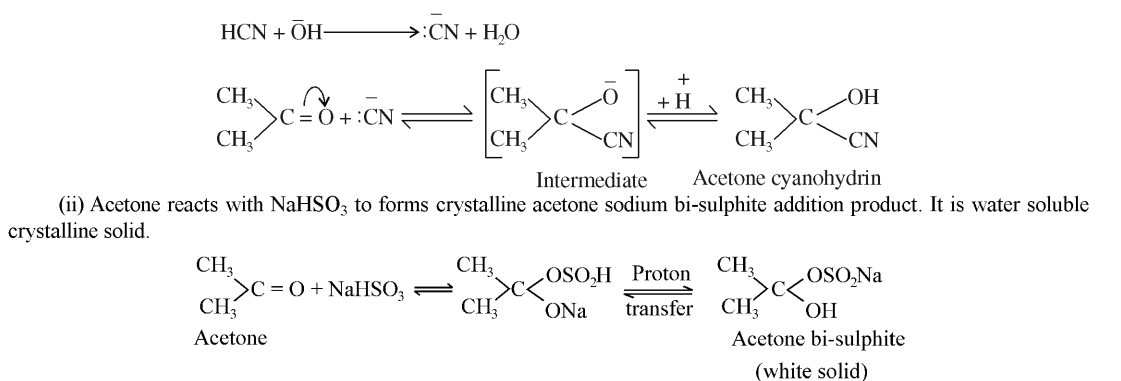
How does acetone reacts with $\ce{HCN}$ and $\ce{NaHSO_3}$?

Answer

$(i)$ When acetone reacts with $\ce{HCN},$ it gives nucleophilic addition product acetone cyanohydrin.
This reaction occurs slowly with pure $\ce{HCN},$ therefore this reaction is carried out in the presence of alkali.​​​​​​​
Image

Need a full question paper?

Generate a complete, print-ready paper with questions like this in minutes — across 16+ boards, with answer keys.
Start Generating Free

Similar questions

Give reason:
(i) Transition elements exhibit higher enthalpies of atomisation.
(ii) In aqueous solution, $Cr ^{2+}$ is stronger reducting agent than $Fe ^{2+}$.
(iii) The second ionisation enthalpy of Cu is higher then $Z n$.
A solution containing $8 g$ of a substance in $100 g$ of diethyl ether boils at $36,86^\circ C,$ whereas pure ether boils at $35.60^\circ C$. Determine the molecular mass of the solute. $($For ether $K_b = 2.02 K \ kg\ mol^{–1}).$
Calculate the molarity of each of the following solutions:
  1. $30\ g$ of $Co(NO_3)_2.\ 6H_2O$ in $4.3\ L$ of solution.
  2. $30\ mL$ of $0.5\ M\ H_2SO_4$ diluted to $500\ mL.$
Why haloalkanes undergo nucleophilic substitution reaction whereas haloarenes undergo electrophilic substitution reaction, why?
Why can we not determine the order of a reaction by taking into consideration the balanced chemical equation?
Write overall cell reaction for lead storage battery when the battery is being charged.
Write a note on Wurtz reaction and its Limitations.
A compound $(X)$ reacts with $PCl_5$ to form compound $Y.$ Compound $Y$ reacts with ethereal solution of magnesium to form compound $(Z),$ which on treating with propanone and further hydrolysis to give $2-$ Methyl propan$-2-ol.$ What are the compounds $X$ and $Y$ and also give the equations of the reactions.
Explain magnetic properties of transition element.
Explain dehydration of alcohols with chemical equations. And also give the order for relative ease of dehydration of alcohols.