Maharashtra BoardEnglish MediumSTD 12 SciencePhysicsMechanical Properties of Fluids4 Marks
Question
How does an aeroplane take off?
✓
Answer
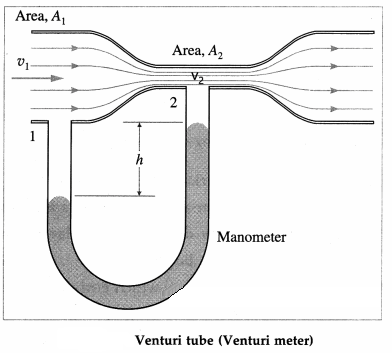
A Venturi meter is a horizontal constricted tube that is used to measure the flow speed through a pipeline. The constricted part of the tube is called the throat. Although a Venturi meter can be used for a gas, they are most commonly used for liquids. As the fluid passes through the throat, the higher speed results in lower pressure at point 2 than at point 1. This pressure difference is measured from the difference in height h of the liquid levels in the U-tube manometer containing a liquid of density $\rho _m. $The following treatment is limited to an incompressible fluid.
Let A1 and A2 be the cross-sectional areas at points 1 and 2, respectively. Let v1 and v2 be the corresponding flow speeds. ρ is the density of the fluid in the pipeline. By the equation of continuity,
$v _1 A _1= v _2 A _2 \ldots \text { (1) }$
Since the meter is assumed to be horizontal, from Bernoufli's equation we get,
$ p_1=\frac{1}{2} \rho v_1{ }^2=p_2+\frac{1}{2} \rho v_2^2$
$\therefore p_1+\frac{1}{2} \rho v_1^2=p_2+\frac{1}{2} \rho v_1^2\left(\frac{A_1}{A_2}\right)^2 \quad \text { [from Eq. (1)] }$
$\therefore p_1-p_2=\frac{1}{2} \rho v_1^2\left[\left(\frac{A_1}{A_2}\right)^2-1\right]$
The pressure difference is equal to ρmgh, where h is the differences in liquid levels in the manometer.
Then,
$\rho_{ m } g h=\frac{1}{2} \rho v_1^2\left[\left(\frac{A_1}{A_2}\right)^2-1\right]$
$\therefore v_1=\sqrt{\frac{2 \rho_{ m } g h}{\rho\left[\left(A_1 / A_2\right)^2-1\right]}}$
Equation (3) gives the flow speed of an incompressible fluid in the pipeline. The flow rates of practical interest are the mass and volume flow rates through the meter.
Volume flow rate =A1v1 and mass flow rate = density × volume flow
rate = ρA1v1
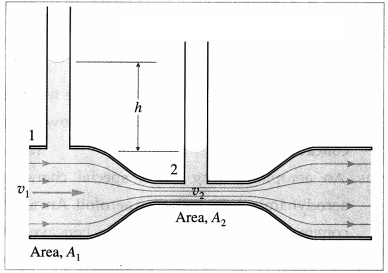
[Note When a Venturi meter is used in a liquid pipeline, the pressure difference is measured from the difference in height h of the levels of the same liquid in the two vertical tubes, as shown in the figure. Then, the pressure difference is equal to ρgh.
$ \rho g h=\frac{1}{2} \rho v_1^2\left[\left(\frac{A_1}{A_2}\right)^2-1\right]$
$\therefore v_1 =\sqrt{\frac{2 g h}{\left[\left(A_1 / A_2\right)^2-1\right]}}$
The flow meter is named after Giovanni Battista Venturi (1746—1822), Italian physicist.]
Need a full question paper?
Generate a complete, print-ready paper with questions like this in minutes — across 16+ boards, with answer keys.