Question
How does Cu2O act as both oxidant and reductant? Explain with proper reactions showing the change of oxidation numbers in each example.

Answer

Cu+ undergoes disproportionation to form Cu2+ and Cu.

$2\text{Cu}^+(\text{aq})\xrightarrow{\ \ \ \ }\text{Cu}^{2+}(\text{aq})+\text{Cu}(\text{s})$

Thus, Cu+ or Cu2O acts both as an oxidant as well as reductant.

  1. When heated in air, Cu2O is oxidised to CuO.

$\stackrel{+1\ \ \ \ \ \ }{\text{Cu}_2}\stackrel{-2\ \ \ }{\text{O}}+\frac12\stackrel{0\ \ \ }{\text{O}_2}\xrightarrow{\ \ \ \ \ \ }2\stackrel{+2\ \ \ \ }{\text{Cu}}\stackrel{-2\ \ }{\text{O}}$

i.e. Cu2O acts as a reductant and reduces O2 to O2-.

  1. When heated with Cu2S, it oxidises S2- to SO2 and hence, Cu2O acts as an oxidant.

$2\stackrel{+1\ \ \ \ \ \ }{\text{Cu}_2}\stackrel{-2}{\text{O}}+\stackrel{+1\ \ \ \ \ }{\text{Cu}_2}\stackrel{-2}{\text{S}}\xrightarrow{\ \ \ \ \ \ }6\stackrel{0\ \ \ \ \ \ }{\text{Cu}}+\stackrel{+4\ \ \ \ \ \ \ }{\text{SO}_2}$

Need a full question paper?

Generate a complete, print-ready paper with questions like this in minutes — across 16+ boards, with answer keys.

Start Generating Free

Similar questions

Use the following data to calculate the $\Delta\text{G}^{\circ}$ for the reaction in which PF5(g) forms from PF3(g) and F2(g) at 298K.

PF3(g) + F2(g) → PF5(g)

$\begin{matrix}\Delta \text{H}^{\circ}_{f} & -919 \text{kJ mol}^{-1} & 0 & -1577 \text{kJ} \text{ K}^{-1} \text{mol}^{-1} \ \\\text{S}^{\circ}& 273 & 203 & 301 \end{matrix}$

Why does benzene undergo electrophilic substitution reactions easily and nucleophilic substitutions with difficulty?
Why is the entropy of a substance taken as zero at 0K?

Calculate the standard Gibbs free energy change for the reaction:

$\text{N}_2(\text{g})+3\text{H}_2(\text{g})\rightleftharpoons2\text{NH}_3(\text{g})$ at 298K

The value of equilibrium constant for the above reaction is 6.6 × 10⁵. [R = 8.314J K-1mol-1]
If the speed of light is 3.0 × 10⁸ ms-1, calculate the distance covered by light in 2.00ns.
What happens when :
(i) ethylene dibromide is heated with zinc.
(ii) solution of sodium succinate is electrolysed.
(iii) ethylene dichloride is heated with zinc.
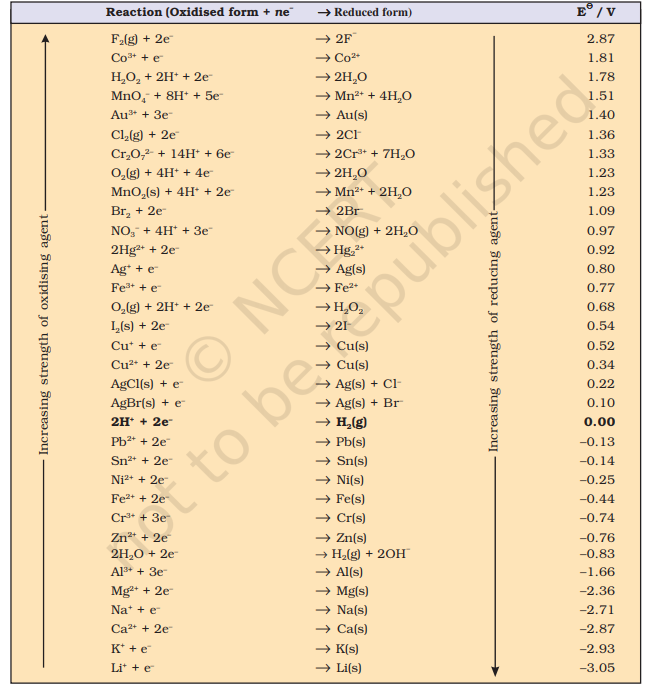
Using the standard electrode potentials given in the Table, predict if the reaction between the following is feasible:

Br2(aq) and Fe2+(aq).
If ice and water are in equilibrium at $0^{\circ} C$ then $\Delta H =6.0 kJ mol ^{-1}$. Find value of $\Delta S$ and $\Delta G$.
If 2L of N2 is mixed with 2L of H at a constant temperature and pressure, then what will be the volume of NH3 formed?
What is meant by the conjugate acid-base pair? Find the conjugate acid/base for the following species:
$\text{HNO}_2,\text{CN}^-,\text{HClO}_4,\text{F}^-,\text{OH}^-,\text{CO}_3^{2-}\text{and S}^{2-}$
How can you predict the following stages of a reaction by comparing the value of Kc and Qc?
  1. Net reaction proceeds in the forward direction.
  2. Net reaction proceeds in the backward direction.
  3. No net reaction occurs.