Question
How does deforestation leads to frequent floods and droughts?

Answer

When the forest trees are cut down, then the lesser number of trees put less water vapour into atmosphere through transpiration. Since, less water vapour is put into the atmosphere, there is less rainfall in that area. When there is less rainfall in an area, then less water percolates into the ground. Due to this, the groundwater level also gets lowered. The shortage of surface water (in ponds, lakes, etc) and groundwater due to persistent low rainfall in an area can lead to droughts. Deforestation also leads to a decrease in the water holding capacity of the soil. When trees are cut down there are no roots for absorbing rain water. Thus, the movement of water from the soil surface into the ground is reduced. So, there are floods. Soil erosion caused by cutting of trees also contributes to floods. The eroded soil keeps on collecting river bed, decreasing its depth. This leads to overflow when heavy rains occur.
Need a full question paper?

Generate a complete, print-ready paper with questions like this in minutes — across 16+ boards, with answer keys.

Start Generating Free

Similar questions

Name two things that are incorrect in the Figure.
Image
Explain the process to decompose water into hydrogen and oxygen.
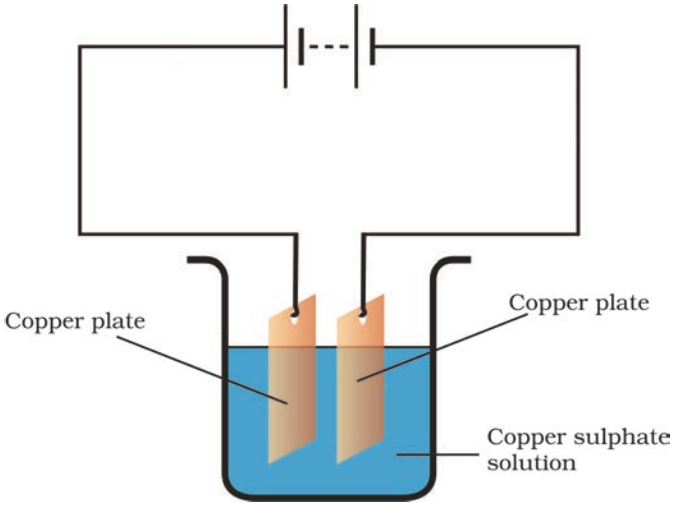
In the circuit given as Figure, Boojho observed that copper is deposited on the electrode connected to the negative terminal of the battery. Paheli tried to repeat the same experiment. But she could find only one copper plate. Therefore she took a carbon rod as negative electrode. Will copper be still deposited on the carbon rod? Explain your answer.

Explain why:
$i.$ A pencil will write on paper but not on glass.
$ii.$ Climbing a greasy pole is very difficult.
‘Avoid plastics as far as possible’. Comment on this advice.
Two very small organisms $X$ and $Y$ both reproduce by the method of budding. Organism $X$ is industrially very important because it is used in making alcohol from sugar. It is also used in making bread. Organisms $Y$ is a tiny animal having tentacles which live in water.
$1.$ What is organisms $X$?
$2.$ Name the process in which $X$ converts sugar into alcohol.
$3.$ To which class of organism does $X$ belong?
$4.$ What are organisms $Y$?
$5.$ Out of $X$ and $Y$, which organism is multicellular and which one is unicellular?
Name one source and one harmful effect of each of the following air pollutants:
$a.$ Sulphur dioxide.
$b.$ Nitrogen oxides.
$c.$ Carbon monoxide.
$d.$ Chlorofluorocarbons $(\text{CFCs})$.
Where are chromosomes found in a cell? State their function.
Explain how sex is determined in the unborn baby.
A new species $X$ is introduced in a forest. How is it likely to affect the local species of that area?