Question
How does electrical resistance depend on the dimensions of an electronic (metallic) conductor?
Answer

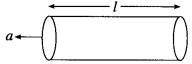
The electrical resistance of an electronic conductor is linearly proportional to its length (l) and inversely proportional to its cross section area a.

Image

Thus, $R \propto l ; R \propto \frac{1}{a}$
$
\therefore R \propto \frac{l}{a} \text { or } R =\rho \times \frac{l}{a}
$
where the proportionality constant $p$ is called specific resistance. IUPAC recommends the term resistivity for specific resistance.

Need a full question paper?

Generate a complete, print-ready paper with questions like this in minutes — across 16+ boards, with answer keys.

Start Generating Free

Similar questions

How will you bring about the following conversions?
acetone to 2-methylpropan-2-ol
An element A and B constitute bcc type crystalline structure. Element A occupies body centre position and B is at the corners of cube. What is the formula of the compound? What are the coordination numbers of A and B ?
On the basis of valence bond theory explain the nature of bonding in $[CoF_6]^{3-}$ ion.
Write the $\text{IUPAC}$ name of $[Co(NO₂)_3 (NH_3)_3].$
Explain the change in entropy for the following processes:
(i) $2 H _2 O _{2 \text { (l) }} \rightarrow 2 H _2 O _{\text {(l) }}+ O _{2 \text { (g) }}$
(ii) $2 H _{2 \text { (g) }}+ O _{2( g )} \rightarrow 2 H _2 O _{\text {(l) }}$
(iii) When ice melts at $0^{\circ} C$ and water vaporises at $100^{\circ} C$.
How does Frenkel defect arise?
Calculate the work done in the following reaction at $50^{\circ} C$. State whether work is done on the system or by the system.
$SO _{2( g )}+\frac{1}{2} O _{2( g )} \longrightarrow SO _{3( g )}$.
The enthalpy change for the atomisation of $10^{10}$ molecules of ammonia is $1.94 \times 10^{-11} kJ$. Calculate the bond enthalpy of $N - H$ bond.
Write reaction to convert acetic acid into methylamine.
A substance crystallizes in fcc structure. The unit cell edge length is $367.8 pm$. Calculate the molar mass of the substance if its density is $21.5 g/cm^3$.
What is the molar mass of a solute if a solution prepared by dissolving $0.822 g$ of it in $0.3 \ dm^3$ of water has an osmotic pressure of $0.196 \ atm.$ at $298 K$?