Question
How does $\mathrm{H}_2 \mathrm{O}_2$ behave as a bleaching agent?

Answer

$\mathrm{H}_2 \mathrm{O}_2$ acts as bleaching agent due to the release of nascent oxygen.
$\mathrm{H}_2 \mathrm{O}_2 \rightarrow \mathrm{H}_2 \mathrm{O}+[\mathrm{O}]$
Thus, the bleaching action of hydrogen peroxide is permanent and is due to oxidation. It oxidises the colouring matter to a colourless product.
$\text{Colouring matter}+[\text{O}]\xrightarrow{\ \ \ \ \ \ \ \ \ \ \ \ \ \ \ \ }\text{Colourless matter}\\ \ \ \ \ \ \ \ \ \ \ \ \ \ \ \ \ \ \ \ \ \ \ \ \ \ \ \ \ \ \ \ \ \ \ \ \ \ \ \ \ \ \ \ \ \ \ \ \ \ \ \ \ \ \ \ \ \ \ \ \ \ \text{(Bleached)}$

Need a full question paper?

Generate a complete, print-ready paper with questions like this in minutes — across 16+ boards, with answer keys.

Start Generating Free

Similar questions

For the reaction : $\text{N}_2\text{(g)}+\text{3H}_2\text{(g)}\rightleftharpoons\text{2NH}_3\text{(g)}$ Equilibrium constant $\text{K}_\text{c}=\frac{[\text{NH}_3]^2}{[\text{N}_2][\text{H}_2]^3}$ Some reactions are written below in Column I and their equilibrium constants in terms of $\text{K}_\text{c}$ are written in Column II. Match the following reactions with the corresponding equilibrium constant.
Column I (Reaction) Column II (Equilibrium constant)
i. $2\text{N}_2\text{(g)}+\text{6H}_2\text{(g)}\rightleftharpoons\text{4NH}_3\text{(g)}$ a. $2\text{K}_\text{c}$
ii. $2\text{NH}_3\text{(g)}\rightleftharpoons\text{N}_2\text{(g)}+\text{3H}_2\text{(g)}$ b. $\text{K}_\text{c}^\frac{1}{2}$
iii. $\frac{1}{2}\text{N}_2\text{(g)}+\frac{3}{2}\text{H}_2\text{(g)}\rightleftharpoons\text{NH}_3\text{(g)}$ c. $\frac{1}{\text{K}_\text{c}}$
    d. $\text{K}_\text{c}^2$
Write four characteristic properties of p-block elements.
Why is the entropy of a substance taken as zero at 0K? Calculate the standard Gibbs free energy change for the reaction:$\text{N}_2(\text{g})+3\text{H}_2(\text{g})\rightleftharpoons2\text{NH}_3(\text{g})$ at 298K
The value of equilibrium constant for the above reaction is $6.6 \times 10^5 \cdot\left[R=8.314 \mathrm{J} \mathrm{~K}^{-1} \mathrm{~mol}^{-1}\right]$
Which of the following are isoelectronic species i.e., those having the same number of electrons?
$\text{Na}^+,\text{K}^+,\text{Mg}^{2+},\text{Ca}^{2+},\text{S}^{2-},\text{Ar}.$
Calculate the volume of 02 at STP liberated by heating 12.25 g of $\mathrm{KClO}_3$ (At. wt. of $\mathrm{K}=39, \mathrm{Cl}=35.5,0=16 \mathrm{u}$ )
How can saline hydrides remove traces of water from organic compounds?
A white solid 'P', on strong heating, decomposes to give reddish brown gas 'R' and a residue 'Q' and a colourless gas. The residue 'R' is yellow when hot and white when cold. The solution of white solid 'P' in water gives white precipitate 'S' with conc. NaOH. The white form colourless solution. Identify 'P', 'Q', 'R', 'S' and write the chemical reactions involved.
Balance the following equations:
  1. $H_3PO3 → H_3PO_4+ PH_3$
  2. $Ca + H_2O → Ca(OH)_2 +H_2$
  3. $Fe_2(SO_4)_3+ NH_3 + H_2O → Fe(OH)_3 + (NH_4)_2SO_4$
  4. $Cl_2+ NaOH → NaCl + NaClO_3 + H_2O$
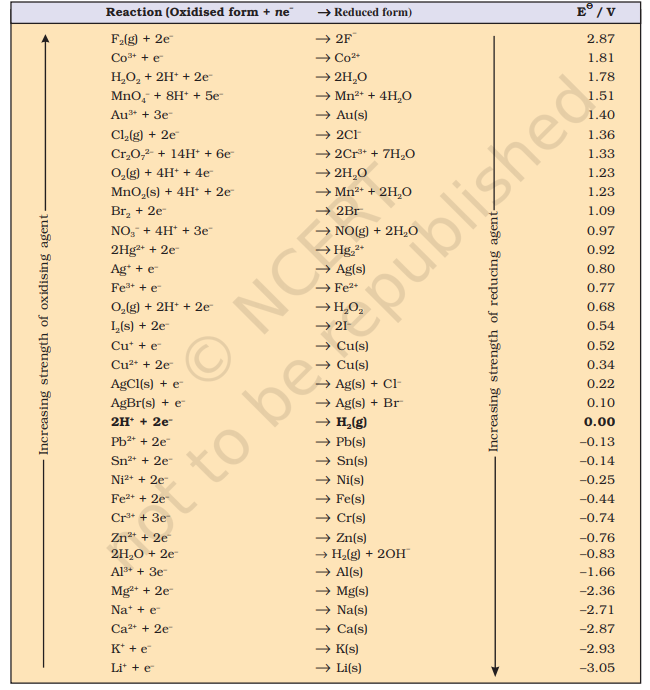
Using the standard electrode potentials given in the Table, predict if the reaction between the following is feasible:

$\mathrm{Br}_2(\mathrm{aq})$ and $\mathrm{Fe}^{2+}(\mathrm{aq})$.
The enthalpy of vaporisation of liquid diethyl ether $\left(\mathrm{C}_2 \mathrm{H}_5\right)_2 \mathrm{O}$ is $26.0 \mathrm{~kJ} \mathrm{~mol}^{-1}$ at its boiling point (35.0°C). Calculate $\Delta\text{S}^\circ$ for the conversion of:
  1. Liquid to vapour.
  2. Vapour to liquid at 35°C.