Question
Using the standard electrode potentials given in the Table, predict if the reaction between the following is feasible:
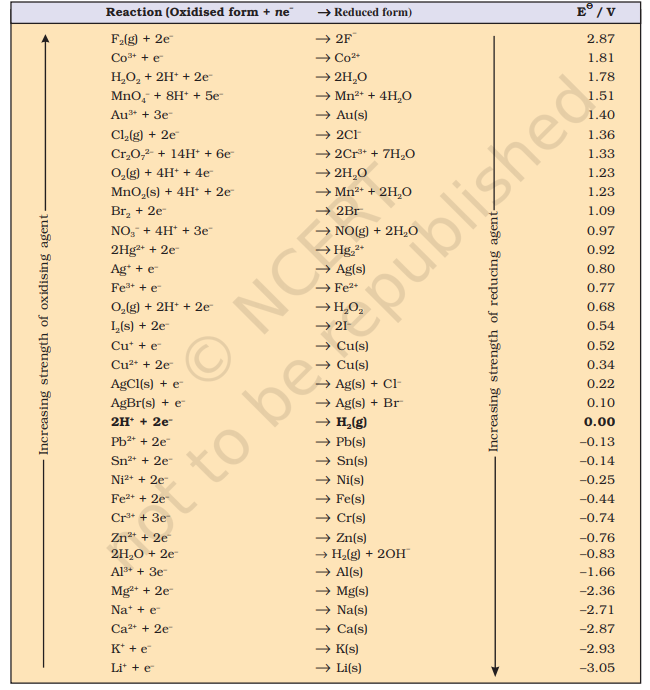
$\mathrm{Br}_2(\mathrm{aq})$ and $\mathrm{Fe}^{2+}(\mathrm{aq})$.

Answer

The possible reaction between $\mathrm{Br}_2(\mathrm{aq})$ and $\mathrm{Fe}^{2+}(\mathrm{aq})$. is given by, $\text{Br}_{2(\text{s})}+2\text{Fe}^{2+}_{(\text{aq})}\rightarrow2\text{Br}^-_{(\text{aq})}+2\text{Fe}^{3+}_{(\text{aq})}$ $\text{Oxidation half equation:}\ \ \ \ \ \ \ \text{Fe}^{2+}_{(\text{aq})}\xrightarrow{\ \ \ \ \ \ }\text{Fe}^{3+}_{(\text{aq})}+\text{e}^-]\times2\ \ ;\text{E}^\circ=-0.77\text{V}\\\text{Reduction half equation:}\ \ \text{Br}^{}_{2(\text{aq})}+2\text{e}^-\xrightarrow{\ \ \ \ \ }2\text{Br}^{-}_{(\text{aq})}\ \ \ \ \ \ \ \ \ ; \text{E}^\circ=+1.09\text{V}\\\overline{\ \ \ \ \ \ \ \ \ \ \ \ \ \ \ \ \ \ \ \ \ \ \ \ \ \ \ \ \ \ \ \ \ \ \ \ \ \ \ \ \ \ \ \ \ \ \ \ \ \ \ \ \ \ \ \ \ \ \ \ \ \ \ \ \ \ \ \ \ \ \ \ \ \ \ \ \ \ \ \ \ \ \ \ \ \ \ \ \ \ \ \ \ \ \ \ \ \ \ \ \ \ \ \ \ \ \ \ \ \ \ \ \ \ \ \ \ \ \ \ \ }\\\ \ \ \ \ \ \ \ \ \ \ \ \ \ \ \ \ \ \ \ \ \ \ \ \ \ \text{Br}^{}_{2(\text{aq})}+2\text{Fe}^{2+}_{(\text{aq})}\xrightarrow{\ \ \ \ \ }2\text{Br}^{-}_{(\text{aq})}+2\text{Fe}^{3+}_{(\text{aq})}\ \ \ \ \ ;\text{E}^\circ=-0.32\text{V}$Here, E° for the overall reaction is positive. Hence, the reaction between $\mathrm{Br}_2(\mathrm{aq})$ and $\mathrm{Fe}^{2+}(\mathrm{aq})$. is feasible.

Need a full question paper?

Generate a complete, print-ready paper with questions like this in minutes — across 16+ boards, with answer keys.

Start Generating Free

Similar questions

221.4J is needed to heat 30 g of ethanol from $15^{\circ} C$ to $18^{\circ} C$. Calculate (a) specific heat capacity, and (b) molar heat capacity of ethanol.
What is meant by the term bond order? Calculate the bond order of $\text{N}_2,\text{O}_2,\text{O}^+_2$ and $\text{O}^-_2.$
What do you understand by the terms:
‘Syngas’.
A 0.02M solution of pyridinium hydrochloride has pH = 3.44. Calculate the ionization constant of pyridine.
Three pairs of compounds are given below. Identify that compound in each of the pairs which has group 13 element in more stable oxidation state. Give reason for your choice. State the nature of bonding also.
i. $\mathrm{TICl}_3, \mathrm{TICl}$.
ii. $\mathrm{AlCl}_3, \mathrm{AlCl}_3$.
iii. $\mathrm{InCl}_3, \mathrm{InCl}$.
  1. Name two important sinks of $\mathrm{CO}_2$.
  2. What is marine pollution?
  3. What is humification?
The alkali and alkaline earth metals characterized by their large atomic sizes, lower ionisation enthalpies, invariable +1 oxidaton state and solubility of their oxo salts. In the light of these features describe the nature of oxides, halides and oxo salts.
Discuss the concept of hybridisation. What are the different types of hybridization that carbon can exhibit?
What is the molecular mass of a substance each molecule of which contains 9 atoms of carbon, 13 atoms of hydrogen and $2.33 \times 10^{-23} \mathrm{~g}$ other component?
How would you react to the statement that the electronegativity of N on Pauling scale is 3.0 in all the nitrogen compounds?