Question
How does nitric acid react with the following ? Give equations.
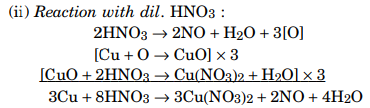
(i) Copper
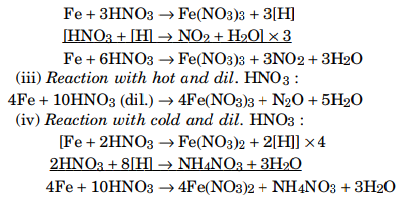
(ii) Iron

Answer

(i) Reaction with hot and conc. $HNO _3$ :
$2 HNO _3 \xrightarrow{\Delta} 2 NO _2+ H _2 O +[ O ]$
$Cu +[ O ] \rightarrow CuO$
Image
Image
Reaction with Iron (Fe) :
(i) Reaction with conc. $HNO _3$ : Iron becomes passive with pure conc. $HNO _3$ i.e. it does not react. As such it becomes due to deposited layer of ferroso ferric-oxide on the surface of iron.
(ii) Reaction with conc. $HNO _3$ :
Image

Need a full question paper?

Generate a complete, print-ready paper with questions like this in minutes — across 16+ boards, with answer keys.

Start Generating Free

Similar questions

  1. Name the three major classes of carbohydrates and give an example of each of these classes.
  2. Answer the following:
  1. What type of linkage is responsible for the primary structure of proteins?
  2. Name the location where protein synthesis occurs in our bod.
The time required for 10% completion of a first order reaction at 298 K is equal to that required for its 25% completion at 308 K. If the value of A is 4 × 10¹⁰ s-1 Calculate k at 318 K and Ea.
Attempt any five of the following:
(a) Which sugar is present in milk?
(b) Why must vitamin C be supplied regularly in diet?
(c) What type of substance is phenylanine hydroxylate? Write its importance.
(d) Define denaturation of protein. What is the effect of denaturation on the structure of protein?
(e) Name the linkage connecting monosaccharide units in polysaccharides.
(f) How do you explain the presence of all six carbon atoms in glucose in a straight chain?
(g) Write the reactions showing the presence of following in the open structure of glucose:
i. a carbonyl group
ii. chain with six carbon atoms
Using IUPAC norms write the formulas for the following:
a. Tetrahydroxozincate(II)
b. Potassium tetrachloridopalladate(II)
c. Diamminedichloridoplatinum(II)
d. Potassium tetracyanonickelate(II)
e. Pentaamminenitrito-O-cobalt(III)
f. Hexaamminecobalt (III) sulphate
g. Potassium tri(oxalato) chromate(III)
h. Hexaammineplatinum(IV)
i. Tetrabromidocuprate(II)
j. Pentaamminenitrito-N-cobalt(III)
Match the compounds/elements given in Column I with uses given in Column II.
 
Column I (Compound/element)
 
Column II (Use)
(i)
Lanthanoid oxide
(a)
Production of iron alloy
(ii)
Lanthanoid
(b)
Television screen
(iii)
Misch metal
(c)
Petroleum cracking
(iv)
Magnesium based alloy is constituent of
(d)
Lanthanoid metal + iron
(v)
Mixed oxides of lanthanoids are employed
(e)
Bullets
 
 
(f)
In X-ray screen
 
Match the complex ions given in Column $I$ with the colours given in Column $II$ and assign the correct code:
 
Column $I ($Complex ion$)$
 
Column $II ($Colour$)$
$a.$ $[Co(NH_3)_6]^{3+}$ $1.$
Violet
$b.$ $[Ti(H_2O)_6]^{3+}$ $2.$
Green
$c.$ $[Ni(H_2O)_6]^{2+}$ $3.$
Pale blue
$d.$ $[Ni(H_2O)_4(en)]^{2+} (aq)$ $4.$
Yellowish orange
 
 
$5.$
Blue
Code:
What is vapour pressure? When a non- volatile solute is dissolved in any liquid, the vapour pressure of the liquid decreases. Give reason.
  1. Name the element of $3d$ transition series which shows maximum number of oxidation states. Why does it show so?
  2. which transition metal of $3d$ series has positive $E^o(M^{2+}/M)$ value and why?
  3. Out of $Cr^{3+}$ and $Mn^{3+}$, which is a stronger oxidizing agent and why?
  4. Name a member of the lanthanoid series which is well known to exhibit $+2$ oxidation state.
  5. Complete the following equation:
$MnO^-_4+8H^++5e^-\rightarrow $
During nuclear explosion, one of the products is 90Sr with half-life of 28.1 years. If $1 \mu g$ of 90Sr was absorbed in the bones of a newly born baby instead of calcium, how much of it will remain after 10 years and 60 years if it is not lost metabolically.
$(a).$ Give reasons for the following:
$(i)$ The reaction of ethanol with acetyl chloride is carried out in the presence of pyridine. Cresols are less acidic than phenol. Williamson's process is used for the preparation of ethers from alkyl halide. Identify the alkyl bromide and sodium alkoxide used for the preparation of $2-$ Ethoxy$-3-$methylpentane
$(c).$ Convert:
$(i)$ Toluene to $3-$nitrobenzoic acid.
$(ii)$ Benzene to $m-$nitroacetophenone.