Question 15 Marks
(a) Give reasons for the following:
(i) Sulphur in vapour state shows paramagnetic behaviour.
(ii) $N - N$ bond is weaker than $P - P$ bond.
(iii) Ozone is thermodynamically less stable than oxygen.
(b) Write the name of gas released when Cu is added to
(i) dilute $HNO _3$ and (ii) conc. $HNO _3$.
(i) Sulphur in vapour state shows paramagnetic behaviour.
(ii) $N - N$ bond is weaker than $P - P$ bond.
(iii) Ozone is thermodynamically less stable than oxygen.
(b) Write the name of gas released when Cu is added to
(i) dilute $HNO _3$ and (ii) conc. $HNO _3$.
Answer
View full question & answer→(a) (i) In gas phase, Sulphur exists mostly as diatomic molecule $S _2$. The bonding in this molecule is similar to that of dioxygen O2. According to molecular orbital theory it has two unpaired electrons in antibonding molecular ( $\pi$ ) orbitals.
(ii) The N-N sigma bond length is less than the P-P sigma bond length. The shorter separation means the nonbonding electrons (lone pairs) on the nitrogen atoms repel each other strongly, making its bond weaker than the P-P bond.
(iii) The enthalpy change for decomposition of ozone has a negative value, it results in liberation of heat :
$2 O _3 \rightarrow 3 O _2 \ldots \Delta H ^{\circ}=-142 kJ / mol$
The increase in number of moles of gas means the entropy change for the reaction is positive. This reinforces the effect of negative enthalpy change, and results in a large negative value of $\Delta G ^{\circ}$ for the decomposition reaction, making it less stable than oxygen.
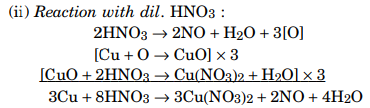
(b) (i) Dilute $HNO _3:$ Nitric oxide, NO.
(ii) Conc. $HNO _3:$ Nitrogen dioxide, $NO _2$.
(ii) The N-N sigma bond length is less than the P-P sigma bond length. The shorter separation means the nonbonding electrons (lone pairs) on the nitrogen atoms repel each other strongly, making its bond weaker than the P-P bond.
(iii) The enthalpy change for decomposition of ozone has a negative value, it results in liberation of heat :
$2 O _3 \rightarrow 3 O _2 \ldots \Delta H ^{\circ}=-142 kJ / mol$
The increase in number of moles of gas means the entropy change for the reaction is positive. This reinforces the effect of negative enthalpy change, and results in a large negative value of $\Delta G ^{\circ}$ for the decomposition reaction, making it less stable than oxygen.
(b) (i) Dilute $HNO _3:$ Nitric oxide, NO.
(ii) Conc. $HNO _3:$ Nitrogen dioxide, $NO _2$.