Question
  1. How does one explain the emission of electrons from a photosensitive surface with the help of Einstein's photoelectric equation?
  2. The work function of the following metals is given: Na 2.75ev, K = 2.3 eV, Mo = 4.17eV and Ni = 5.15eV. Which of these metals will not cause photoelectric emission for radiation of wavelength 3300 Å from a laser source placed 1m away from these metals? What happens if the laser source is brought nearer and placed 50cm away?
Answer

  1. Einstein’s Photoelectric equation is
$hv=\varphi_0+K_{\text{max}}$

When a photon of energy $'hv'$ is incident on the metal, some part of this energy is utilised as work function to eject the electron and remaining energy appears as the kinetic energy of the emitted electron.
  1. $E=\frac{hc}{\lambda}=\frac{6.63\times10^{-34}\times3\times10^8}{3.3\times10^{-7}\times1.6\times10^{-19}}eV$
$=3.77\text{eV}$

The work function of Mo and Ni is more than the energy of the incident photons; so photoelectric emission will not take place from these metals. Kinetic energy of photo electrons will not change, only photoelectric current will change.

Need a full question paper?

Generate a complete, print-ready paper with questions like this in minutes — across 16+ boards, with answer keys.

Start Generating Free

Similar questions

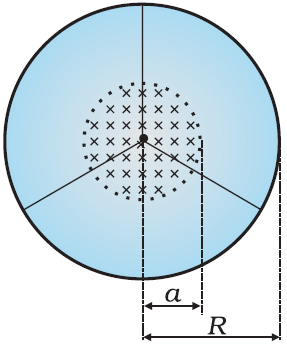
A line charge $\lambda$ per unit length is lodged uniformly onto the rim of a wheel of mass M and radius R. The wheel has light non-conducting spokes and is free to rotate without friction about its axis (Fig.). A uniform magnetic field extends over a circular region within the rim. It is given by,
$B = – B_0k (r ≤ a; a < R)$
= 0 (otherwise)
What is the angular velocity of the wheel after the field is suddenly switched off?
Two particles of masses $m_1$ and $m_2$ are joined by a light rigid rod of length r. The system rotates at an angular speed co about an axis through the centre of mass of the system and perpendicular to the rod. Show that the angular momentum of the system is $\text{L}=\mu\text{r}^2\omega$ where $\mu$ is the reduced mass of the system defined as $\mu=\frac{\text{m}_1\text{m}_2}{\text{m}_1+\text{m}_2}.$
  1. At what distance should the lens be held from the figure in Exercise 9.29 in order to view the squares distinctly with the maximum possible magnifying power?
  2. What is the magnification in this case?What is the magnification in this case?
  3. Is the magnification equal to the magnifying power in this case? Explain.
For a system made of two very long coaxial solenoids, explain mutual inductance. Prove $M _{12}= M _{21}= M \ ($Reciprocity Theorem$)$.
If a charge is placed at rest in an electric field, will its path be along a line of force? Discuss the situation when the lines of force are straight and when they are curved.
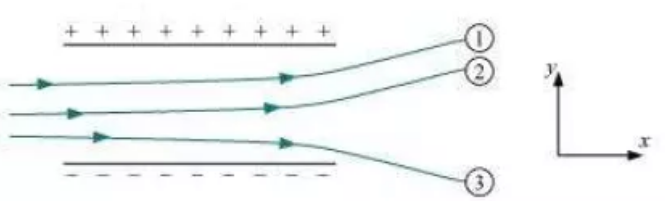
Figure 1.33 shows tracks of three charged particles in a uniform electrostatic field. Give the signs of the three charges. Which particle has the highest charge to mass ratio?
Two long parallel wires are 8 cm apart. Currents of magnitudes $i$ and $3 i$ are flowing in them respectively in the same direction. Where the resultant magnetic field due to two will be zero?
A circular loop of radius r carries a current i. How should a long, straight wire carrying a current 4i be placed in the plane of the circle so that the magnetic field at the centre becomes zero?
Give reasons for each of the following:
  1. The intensity of light at some points on the screen in Young’s double slit experiment is zero.
  2. The intensity of light transmitted by a polaroid is less than the intensity of the unpolarised light incident on it.
  3. In the single slit diffraction experiment, some coloured fringes around the central white maximum are observed on the screen when one uses a source of white light.
State the principle of working of a galvanometer.
A galvanometer of resistance G is converted into a voltmeter to measure upto V volts by connecting a resistance R1 in series with the coil. If a resistance R2 is connected in series with it, then it can measure upto V/2 volts. Find the resistance, in terms of R1 and R2, required to be connected to convert it into a voltmeter that can read upto 2 V. Also find the resistance G of the galvanometer in terms of R1 and R2.