Question
How does replication of the long DNA molecule occur? Explain the process.

OR

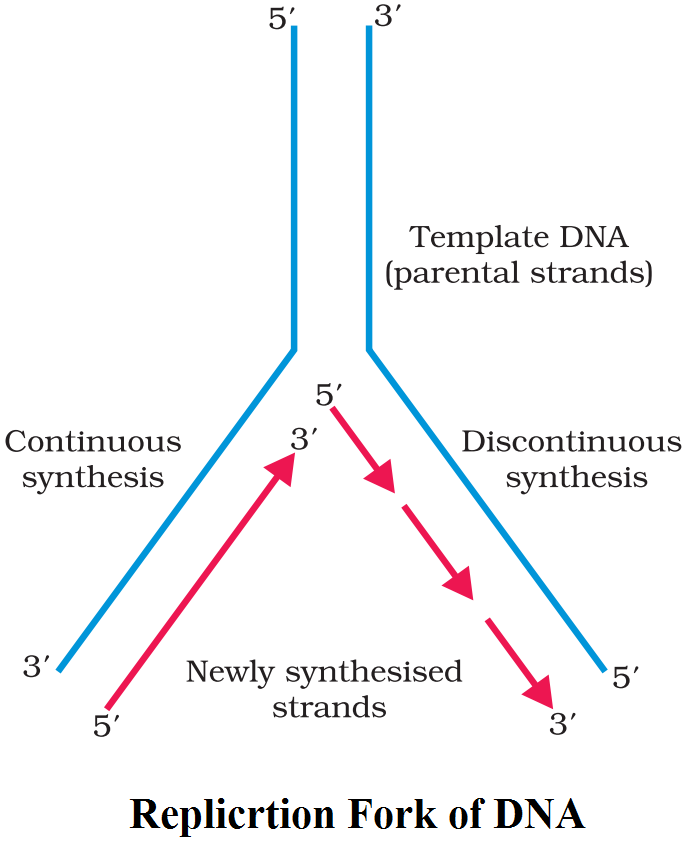
Explain the process of DNA replication with the help of a replicating fork.
Answer

  1. Replication of DNA.
  2. Replication of DNA occurs during S-phase of cell cycle.
  3. During replication of DNA, the two strands unwind upto a point and a replication fork is formed.
  4. Since the unwinding cannot take place for the entire length, replicaion starts from the replication fork.
  5. Both the strands act as templates for DNA synthesis.
  6. DNA polymerase is the enzyme that polymerises the bases/ nucleotides into a strand of DNA.
  7. Since this enzyme polymerises the nucleotides in 5' → 3' direction only, on one of the template strands (with 3' → 5' polarity), the new strand is synthesised as a continuous stretch (leading strand); it is called continuous synthesis.
  8. On the other template strand, (with 5' → 3' polarity), DNA strand is synthesised as short stretches (using primers), called Okazaki fragments; this is called discontinuous synthesis.
  9. Later, these short stretches are joined by DNA-ligase (lagging strand).

Need a full question paper?

Generate a complete, print-ready paper with questions like this in minutes — across 16+ boards, with answer keys.


Start Generating Free