MCQ
How does retarding potential vary with the frequency of light causing photoelectric effect?
- AInfinite
- BZero
- CDecreases
- DIncreases
Explanation:
The stopping potential is directly proportional to the frequency of light.
Hence, the stopping potential increases with an increase in the frequency of the incident light.
Generate a complete, print-ready paper with questions like this in minutes — across 16+ boards, with answer keys.
An oscillator is producing FM waves of frequency 2 kHz with a variation of 10 kHz. What is the modulating index
|
(a) 0.20 |
(b) 5.0 |
(c) 0.67 |
(d) 1.5 |
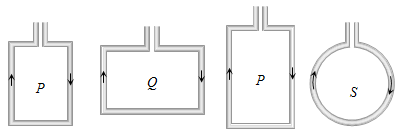
Four wires each of length 2.0 metres are bent into four loops P, Q, R and S and then suspended into uniform magnetic field. Same current is passed in each loop. Which statement is correct
|
(a) Couple on loop P will be the highest |
(b) Couple on loop Q will be the highest |
|
(c) Couple on loop R will be the highest |
(d) Couple on loop S will be the highest |
The dipole moment of each molecule of a paramagnetic gas is 1.5 × 10⁻²³ amp × m2. The temperature of gas is 27oC and the number of molecules per unit volume in it is 2 × 1026 m–3. The maximum possible intensity of magnetisation in the gas will be
|
(a) 3 × 10³ amp/m |
(b) 4 × 10⁻³ amp/m |
(c) 5 × 10⁵ amp/m |
(d) 6 ×10⁻⁴ amp/m |
Four condensers are joined as shown in the adjoining figure. The capacity of each is 8 μF. The equivalent capacity between the points A and B will be

|
(a) 32 μF |
(b) 2 μF |
(c) 8 μF |
(d) 16 μF |
In AM, the centpercent modulation is achieved when
|
(a) Carrier amplitude = signal amplitude |
(b) Carrier amplitude ≠ signal amplitude |
|
(c) Carrier frequency = signal frequency |
(d) Carrier frequency ≠ signal frequency |