Skeleton and Movement — Biology STD 11 Science — Question
Maharashtra BoardEnglish MediumSTD 11 ScienceBiologySkeleton and Movement5 Marks
Question
How does structure of actin and myosin help muscle contraction?
✓
Answer
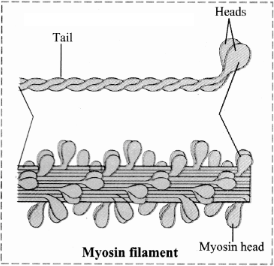
i. Myosin filament:
Each myosin filament is a polymerized protein.
Many meromyosins (monomeric proteins) constitute one thick filament.
Myosin molecule consists of two heavy chains (heavy meromyosin / HMM) coiled around each other forming a double helix. One end of each of these chains is projected outwardly is known as cross bridge. This end folds to form a globular protein mass called myosin head.
Two light chains are associated with each head forming $4$ light chains/light meromyosin / LMM.
Myosin head has a special ATPase activity. It can split ATP to produce energy.
Myosin contributes $55 \%$ of muscle proteins.
In sarcomere, myosin tails are arranged to point towards the centre of the sarcomere and the heads point to the sides of the myofilament band.
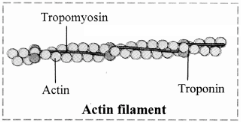
ii. Actin filament: It is a complex type of contractile protein. It is made up of three components:
F actin: It forms the backbone of actin filament. F actin is made up of two helical strands. Each strand is composed of polymerized G actin molecules. One ADP molecule is attached to G actin molecule.
Tropomyosin: The actin filament contains two additional protein strands that are polymers of tropomyosin molecules. Each strand is loosely attached to an F actin. In the resting stage, tropomyosin physically covers the active myosin-binding site of the actin strand.
Troponin: It is a complex of three globular proteins, is attached approx. $2/3^{rd}$ distance along each tropomyosin molecule. It has affinity for actin, tropomyosin and calcium ions. The troponin complex is believed to attach the tropomyosin to the actin. The strong affinity of troponin for calcium ions is believed to initiate the contraction process.
Need a full question paper?
Generate a complete, print-ready paper with questions like this in minutes — across 16+ boards, with answer keys.