Question
How does the elements having similar properties are placed in the same group or period?

Answer

The chemical properties of elements are determined by their valence shell electronic configuration.
For example: The group 15 (nitrogen family),
The valence shell (outermost shell) electronic configuration of is $ns _2 np _3$, which clearly shows that all the elements have the tendency to make same kind if bonds with a common element. That is, consider the hydrates of the group, it is $NH _3$ (ammonia), $PH _3$ (phosphine), $AsH _3$ (arsine), $SbH _3$ (stibine) etc. They are having the same chemical formula and same type of bond (covalent bond) The physical properties include melting point, boiling point, density etc. Here for the same nitrogen family, all elements except nitrogen are solids in room temperature whereas nitrogen is gas. melting point (degree C ) is as shown below:
- $N :-209.86$
- P: 44.81
- As: 817
- Sb: 630.5
- Bi: 271.3

Here the physical properties shows a great variation. From the examples sighted above, even though the chemical properties exhibits almost same chemical properties, they doesn't follow same trend in physical properties.

Need a full question paper?

Generate a complete, print-ready paper with questions like this in minutes — across 16+ boards, with answer keys.
Start Generating Free

Similar questions

What happens when a beam of sunlight enters a dusty room through a window? Explain your answer.
An element A from group 14 of the periodic table combines with an element B from group 16.
  1. What type of chemical bond is formed?
  2. Give the formula of the compound formed.
Why do acids not show acidic behaviour in the absence of water?
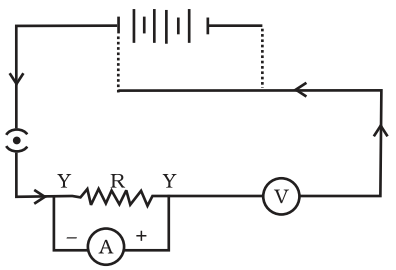
A child has drawn the electric circuit to study Ohm’s law as shown in Figure. His teacher told that the circuit diagram needs correction. Study the circuit diagram and redraw it after making all corrections.
Separate the following into substances having pH values above and below 7. How do these influence litmus paper?
What is meant by a renewable source of energy? Give two examples of renewable sources of energy.
Nitrogen (atomic number 7) and phosphorus (atomic number 15) belong to group 15 of the Periodic Table. Write the electronic configuration of these two elements. Which of these will be more electronegative? Why?
A convex lens forms a real and inverted image of a needle at a distance of 50 cm from it. Where is the needle placed in front of the convex lens if the image is equal to the size of the object? Also, find the power of the lens.
i. Construct a terrestrial food chain comprising four trophic levels.
ii. What will happen if we kill all the organisms in one trophic level?
iii. Calculate the amount of energy available to the organisms at the fourth trophic level if the energy available to the
organisms at the second trophic level is 2000 J.
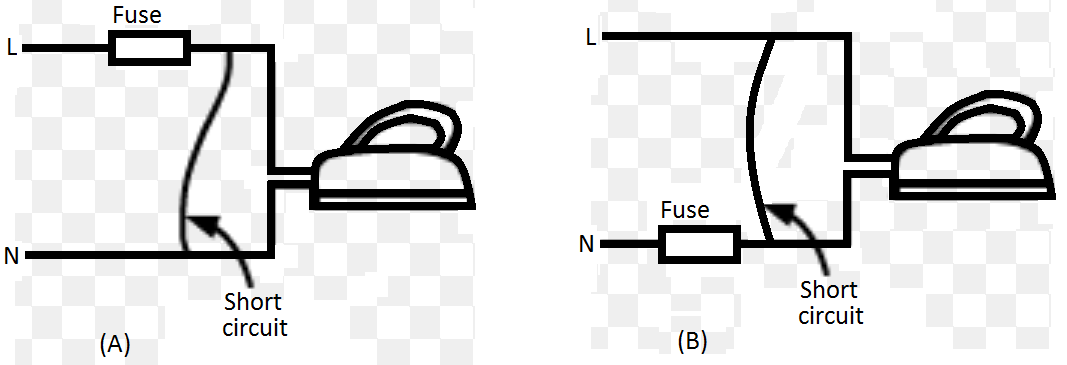
Which of the following circuits will still be dangerous even if the fuse blows off and electric iron stops working during a short circuit?