Question
How does the resistance of a wire depend on its radius? Explain your answer.

Answer

Resistance of a wire is inversely proportional to the area of cross-section of the wire.
$\begin{aligned} & R \propto \frac{1}{A} \\ & R \propto \frac{1}{\pi r 2}\end{aligned}$
This means if a wire of same length, but of double radius is taken, its resistance is found to be one-fourth.

Need a full question paper?

Generate a complete, print-ready paper with questions like this in minutes — across 16+ boards, with answer keys.
Start Generating Free

Similar questions

(a) Draw a sketch to show how a lens is able to produce an image of the sun on a paper screen.
(b)(i) Would you regard the rays from the sun as being divergent, parallel or convergent?
(ii) What is the name given to the point where such rays meet after they have passed through the lens?
(iii) How does the image of the sun sometimes burn a paper screen?
Define the term refractive index of a medium. What do you understand by the statement 'the refractive index of glass is 1.5 for white light'?
A coolie is pushing a box weighing 1500 N up an inclined plane 7.5 m long on to a platform, 2.5 m above the ground.
(i) Calculate the mechanical advantage of the inclined plane. (ii) Calculate the effort applied by the coolie.
(iii) In actual practice, the coolie needs to apply more effort than what is calculated. Give one reason why you think the coolie needs to apply more effort.
A battery of e.m.f. 15 V and internal resistance$2 \Omega$ is connected to tvvo resistors of 4 ohm and 6 ohm joined.
(i) In series,
(ii) In para 1 lel. Find in each case the electrica I energy spent per minute in 6 ohm resistor.
Calculate the time taken by an immersion heater, which supplies energy at the rate of 7000 J/minute to raise temp. of 5 kg water from 22°C to 47°C.
State the medical use of radioactivity.
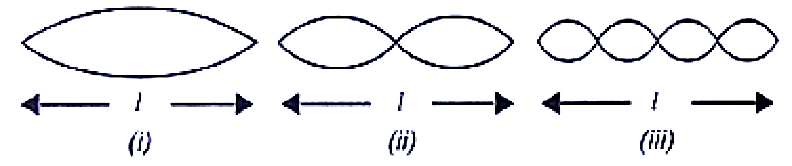
The following diagram shows three ways in which the string of an instrument can vibrate.


(a) which of the diagram shows the principal note?
(b) which has the frequency four times that of the first?
(c) what is the ratio of the frequency of the vibration in (i) and (ii)?
Where should an object be placed in front of a convex lens of focal length 0.12 m to obtain a real image of size three times the size of the object, on the screen?
A body of mass $m$ falls from a height $h_1$ to a height $h_2$, above the ground $\left(h_1>h_2\right)$. What is the loss of potential energy?
A light ray of yellow colour is incident on an equilateral glass prism at an angel of incidence equal to 48° and suffers minimum deviation by an angle of 36°. (i) What will be the angle of emergence? (ii) If the angle of incidence is changes to (a) 30°, (b) 60°, state whether the angle of deviation will be equal to, less than or more than 36° ?